Semi Automatic vs Fully Automatic Shrink Wrapping Machine: Which One Makes Sense for Your Production Line?
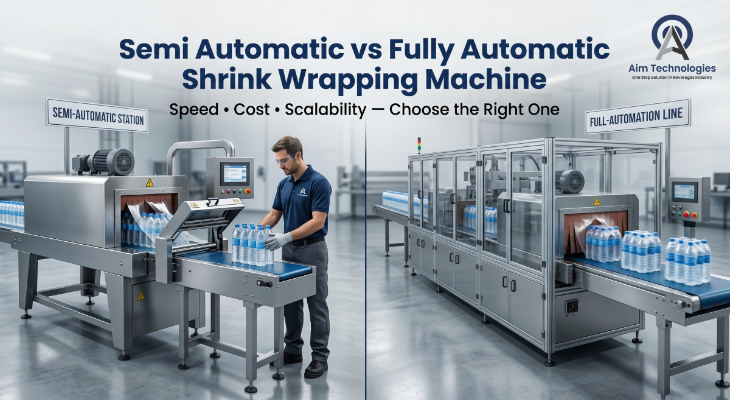
The question gets asked constantly — semi automatic or fully automatic shrink wrapping machine? One costs less upfront. The other runs faster. Neither answer is universally right, and choosing the wrong type for your production stage can cost more than the price difference over two years.
This guide gives you the practical framework to decide. No sales pitch for either option — just the honest comparison that helps you spend money in the right place.
What a Shrink Wrapping Machine Does
Shrink wrapping wraps products in thermoplastic film, then passes them through a heated tunnel where the film contracts tightly. The result: a firm, tamper-evident, professional-looking package that holds its shape through transport and stacking.
For beverage businesses — water plants especially — this is how individual bottles become retail packs. A pack of six 1-litre water bottles grouped and wrapped together is produced by a shrink wrapping machine. The quality of that wrap directly affects how your product looks on a shelf and how well it survives the delivery route.
Semi Automatic — Practical, Flexible Entry Point
A semi automatic machine requires an operator to place products and initiate each cycle. The sealing and shrinking are automated — but a person is present throughout the process.
This isn't always a disadvantage. For operations handling varied product sizes, mixed pack formats, or irregular production runs, having an operator in the loop gives you flexibility that's genuinely harder to replicate with full automation.
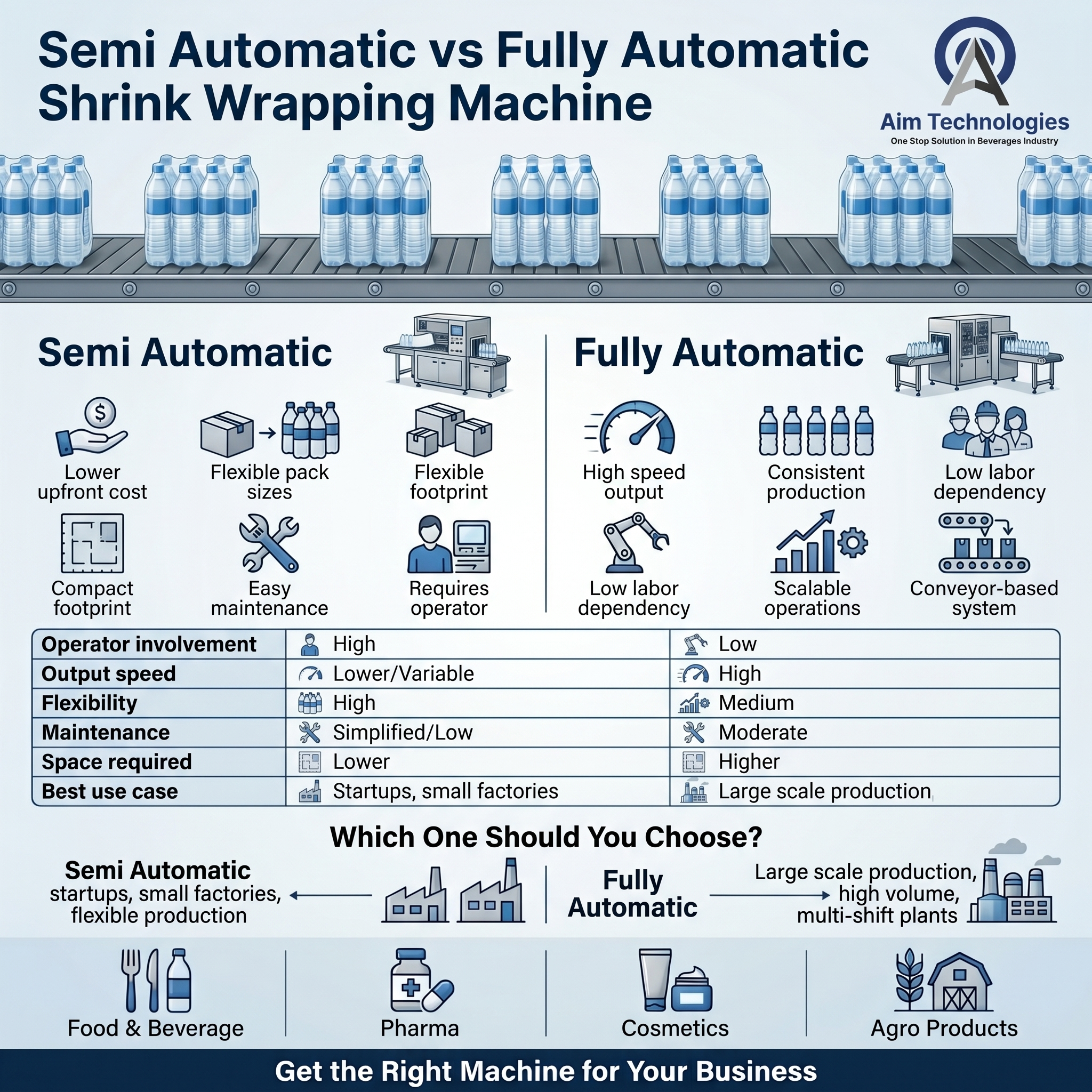
- Lower upfront investment than fully automatic models
- Format flexibility — easy to switch between pack sizes (4-pack, 6-pack, 12-pack)
- Compact footprint — works in tighter factory spaces
- Simpler maintenance — fewer automated components to service
- One trained operator can run it comfortably throughout a shift
Fully Automatic — Consistent Output at Scale
A fully automatic machine handles product feeding, grouping, sealing, and shrinking continuously — no manual involvement at each cycle. Products arrive on a conveyor. The machine does the rest.
The primary value here isn't just speed — it's output consistency. A fully automatic line runs at the same fixed, programmable pace across every shift, regardless of which operator is monitoring it. For operations supplying large institutional accounts or retail chains with strict delivery requirements, this consistency is what the investment is actually buying.
- Fixed, programmable output speed — same pace every shift
- One operator can monitor multiple machines simultaneously
- Eliminates operator fatigue as a production variable
- Aim Technologies' range extends to the 200 BPM linear shrink wrapping machine for high-speed production lines
Side-by-Side Comparison
| Feature | Semi Automatic | Fully Automatic |
|---|---|---|
| Operator involvement | Active at each cycle | Supervisory only |
| Output speed | Varies with operator | Fixed & programmable |
| Format flexibility | Higher ✓ — easy changeovers | More setup per format |
| Factory footprint | Compact ✓ | Larger floor space needed |
| Maintenance | Simpler ✓ | More components to service |
| Labour dependency | Higher — dedicated operator | Lower ✓ — one monitors several |
| Finished pack quality | Retail-ready ✓ | Retail-ready ✓ |
| 📌 Both machine types produce identical finished packaging quality. The difference is operational efficiency, not output appearance. | ||
🏭 Not sure which model fits your line?
Tell us your production requirement — we'll recommend the right machine and capacity for free.
Which One Is Right for Your Business?
The most useful framing isn't "which is better" — it's "which is appropriate for where my production is right now."
There's a third scenario worth mentioning — and it comes up more often than people admit. Some businesses start with a semi automatic machine, find it working well, and simply never upgrade. Not because they're running at low volume forever, but because they've optimised around two operators running the semi automatic efficiently, and the output fully meets their market demand. That's a valid business decision. The upgrade to fully automatic is only necessary when the semi automatic genuinely becomes the bottleneck.
Industries That Use Shrink Wrapping Machines
Food & Beverage
Packaged drinking water, juices, soft drinks. This is the largest segment. Shrink wrapping machines group individual bottles into retail multipacks and provide the tamper-evident outer layer required by retailers and regulators alike.
Pharmaceuticals
Tamper evidence and moisture protection for cartons, bottles, and blister packs. Standards are higher here — material compatibility with drug packaging regulations applies.
Cosmetics & Personal Care
Retail gift sets and individual bottles. Visual finish quality matters as much as protection. The clarity and uniformity of the shrink film is what gets a brand onto premium retail shelves.
Pesticides & Agro Products
Secondary packaging for agricultural inputs. The emphasis is on structural integrity through transport and storage in varied weather conditions rather than retail aesthetics.
Aim Technologies' full range of shrink wrapping machines — both semi automatic and fully automatic — is built to serve all of these industries.
Mistakes Buyers Make When Choosing
A business projects optimistic first-year volume, buys a high-speed fully automatic machine, and spends twelve months running at a fraction of capacity. A semi automatic would have served them better for two years and kept capital free for distribution and market development.
Three shifts daily × one dedicated operator × two years is significant. If you're running multiple shifts every day, do the full labour cost comparison honestly before defaulting to the cheaper upfront option.
Your shrink wrapping machine and filling machine must be matched in throughput. A filling machine producing bottles faster than your packaging machine can wrap them creates a bottleneck immediately after commissioning. Always select these as a matched system.
A machine without properly trained operators underperforms regardless of specification. Confirm that on-site installation and operator training are included before finalising any purchase. Aim Technologies provides both as part of machine delivery.
Frequently Asked Questions
Looking for a Shrink Wrapping Machine?
Tell us your production requirement — we'll recommend the right machine and capacity for your line. We supply across India and internationally.

🏭 Need a Shrink Wrapping Machine?
Get expert advice and a free quote matched to your production line.
📱 WhatsApp Now