3000 LPH Mineral Water Plant: Cost, Profit Margin, and ROI India 2026
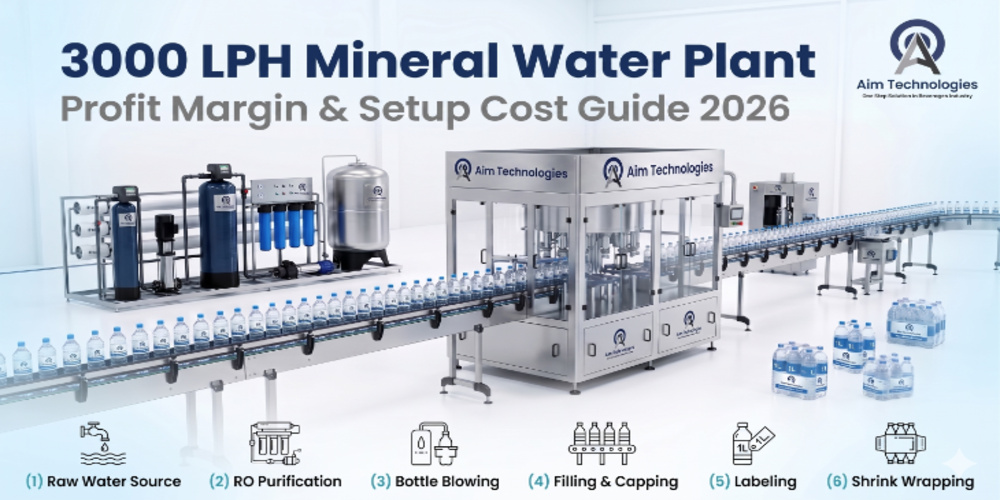
The 3000 LPH mineral water plant profit margin in India is one of the most searched — and most misunderstood — topics for anyone entering the packaged drinking water business. People want a number. A clean, confident answer. The reality is a bit messier, and that's exactly why this article is worth reading before you commit a single rupee.
A 3000 LPH plant is where operators looking to run a medium-scale production line begin. It's a genuinely workable entry point — not too small to be taken seriously by retailers, not so large that you're funding a full commercial line before you've proven your distribution. But the profit story depends heavily on things most machinery sellers won't tell you upfront: civil costs, licence timelines, power requirements, and the first six months before you hit consistent volume.
Why 3000 LPH Is a Strong Production Entry Point for Serious Operators
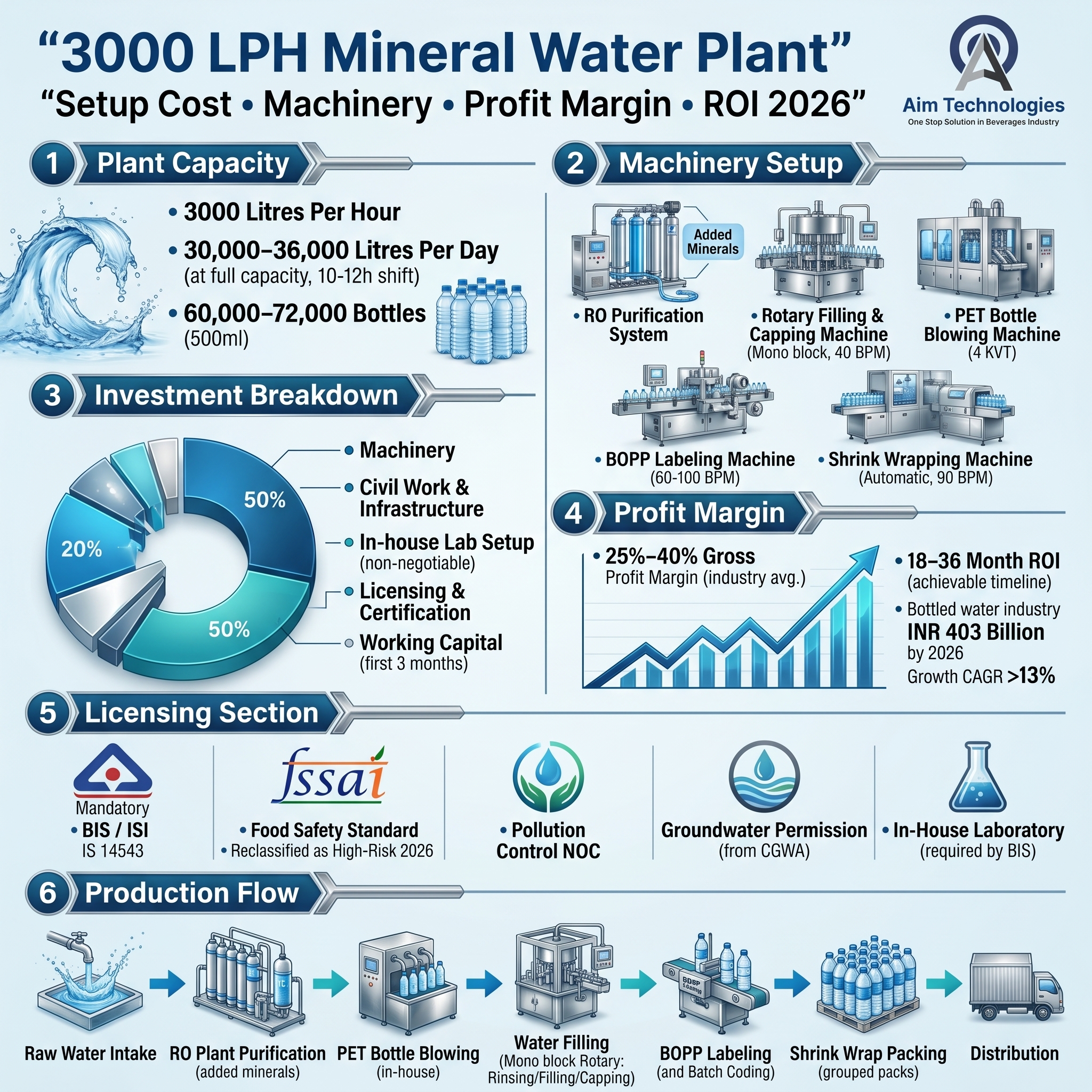
A 3000 LPH (litres per hour) plant produces exactly that — 3,000 litres of treated, bottled drinking water every hour of operation. Running a 10–12 hour production shift, that's 30,000–36,000 litres per day. In 500ml bottles, that's 60,000–72,000 bottles. In 1-litre bottles, 30,000–36,000 bottles. Those are serious, commercial-scale volumes.
This capacity sits in an interesting space. It's substantial enough to supply local retail shops, schools, small hotels, restaurants, and office buildings — the backbone of most new packaged water brands. It requires a well-organized team — typically 4–6 operators — to run all production stages efficiently.
The honest caveat: 3000 LPH doesn't mean you'll hit 36,000 litres on Day 1. Most plants run at 50–70% capacity in the first few months while distribution networks are being built. Planning around realistic utilisation is what separates successful operators from those who go back to look for financing six months in.
What a 3000 LPH Plant Actually Produces — Numbers Worth Knowing
Before looking at costs and margins, it helps to get the production picture clear. A 3000 LPH RO system treats raw water at 3,000 litres per hour and is designed to run continuously for 10–12 hours per production shift. Your bottling line — filling, capping, labeling, packaging — runs at a different pace depending on your machinery choice. The filling machine speed (measured in BPM — bottles per minute) determines how quickly the line actually processes bottles, not the RO system alone.
A 3000 LPH plant corresponds to the 40 BPM plant configuration in Aim Technologies' turnkey mineral water project range (40 BPM to 200 BPM). The 40 BPM mono block rotary filling machine — with 8 rinsing heads, 8 filling heads, and 4 capping heads running at 3 KW — is the exact-matched unit for this capacity. A mono block rotary machine handles rinsing, filling, and capping in one compact unit with no-bottle-no-fill sensors, keeping the production footprint tight and the process contamination-free. This configuration gives you room to step up to the 60 BPM or 90 BPM model as your distribution grows, without needing to replace the entire line.
- Daily output at 10–12 hours: 30,000–36,000 litres of treated water
- 500ml bottles: 60,000–72,000 bottles per day at full capacity
- 1-litre bottles: 30,000–36,000 bottles per day at full capacity
- Space needed: Industry estimates suggest 3,000–5,000 sq.ft. is typically sufficient for a 3000 LPH plant including processing, storage, and packaging zones
- Realistic first-year utilisation: 50–70% of theoretical capacity while distribution builds
Setup Cost — What You're Really Paying For
The cost question is what everyone asks first, and it's also the question that gets the most misleading answers. A machinery quote is not the same as a project cost. Many entrepreneurs are surprised to find that the machinery is often less than 50% of the actual capital required to go live.
For a packaged drinking water plant 3000 LPH in India, here's an honest breakdown of what you're actually paying for:
| Cost Component | What It Covers | Nature |
|---|---|---|
| RO Purification System | 40 BPM configuration: 3,000 LPH product storage, 6,000 LPH raw water storage, 9 KW power load — includes pressure sand filter, activated carbon filter, MCF, RO membrane, anti-scalant dosing, UV steriliser, ozone generator, Added Mineral Technology | One-time |
| Water Filling Machine | 40 BPM mono block rotary (8 rinsing heads, 8 filling heads, 4 capping heads; 3 KW; SS316L water-contact parts; no-bottle-no-fill sensor; non-contact counters; separate cap elevator) | One-time |
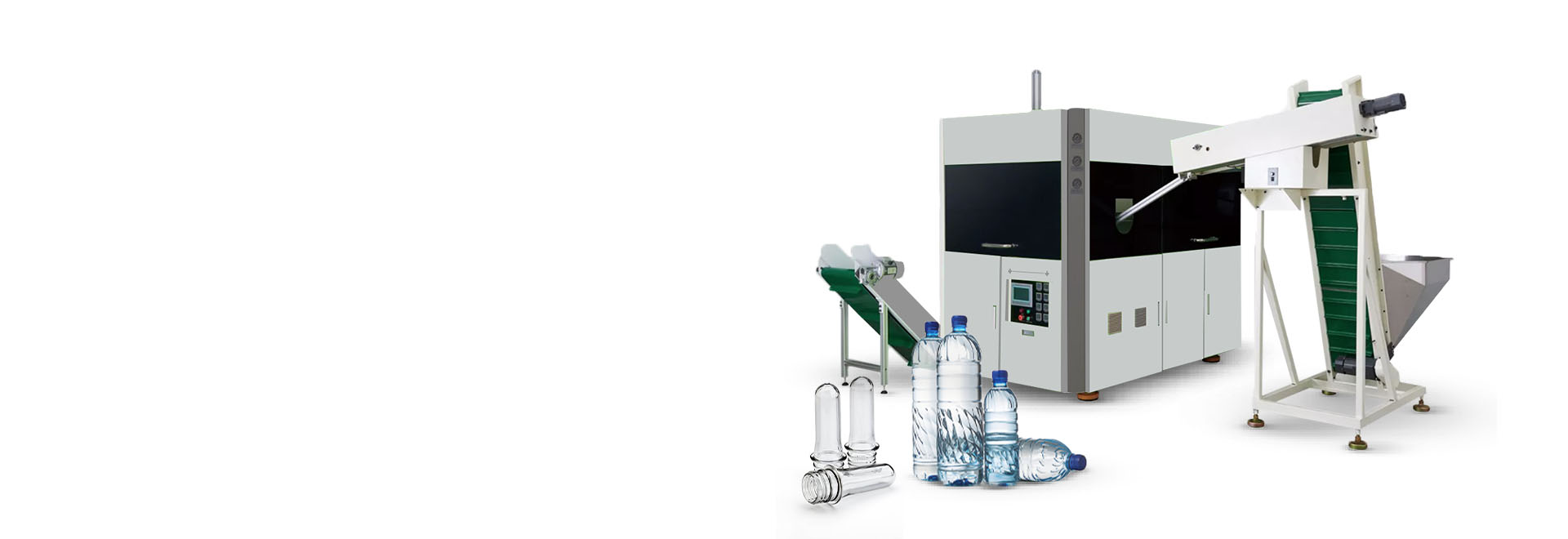
| PET Blowing Machine | 4 KVT model (3,000 BPH, 1,000 ML max volume, 300 MM max height, 33 KW) — produces bottles in-house; or preform sourcing from market | One-time / recurring |
| Labeling Machine | BOPP Labeling Machine (60–100 BPM, SS304, vacuum system, PLC control, no-bottle-no-label mechanism; variable speed drive) — matched to a 40 BPM filling line; or Sticker Labeling Machine (7-inch touch HMI, operator-free) | One-time |
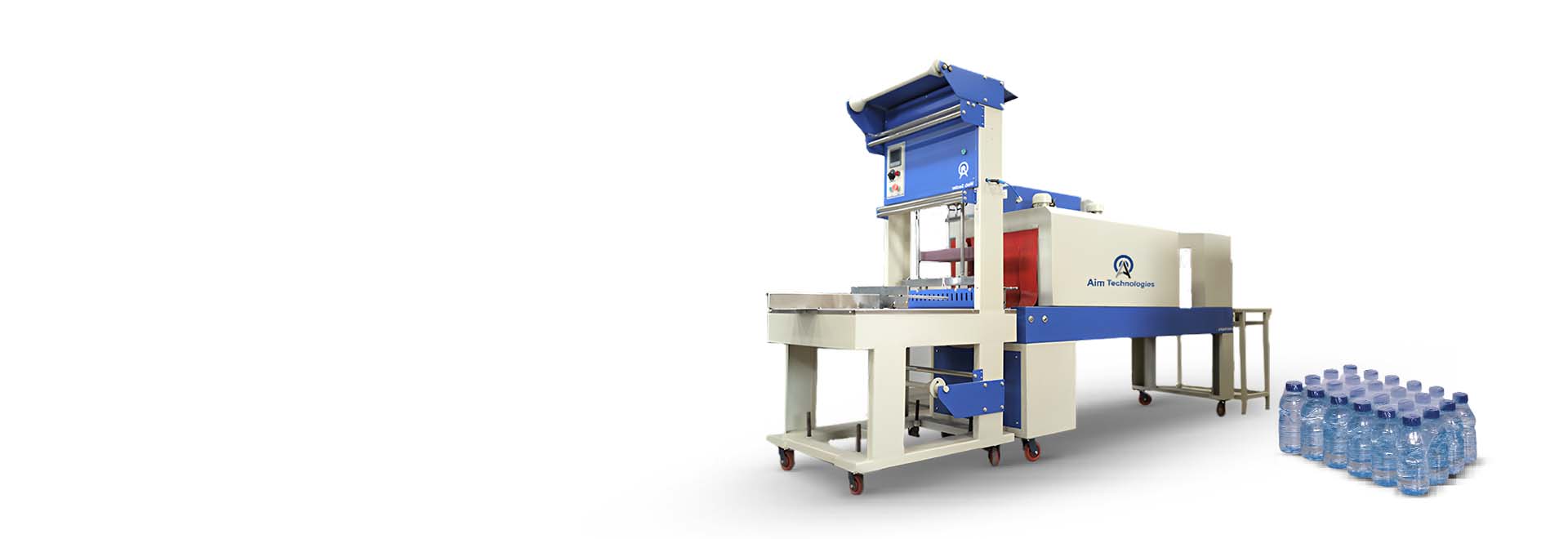
| Shrink Wrapping Machine | 90 BPM Automatic Shrink Wrapping Machine: 8 packs/min, 25 KW, 12 CFM, 200–2000 ML — matched to a 40 BPM filling line (40 btl/min ÷ 6-pack = ~7 packs/min needed) | One-time |
| BIS/ISI Licensing | Application, lab testing, inspection fees | One-time + annual |
| FSSAI Registration | State or central FSSAI licence | Annual |
| In-house Lab Setup | BIS mandated — physical, chemical, microbiological tests | One-time + ongoing |
| Civil & Infrastructure | Flooring, drainage, electrical, plumbing, storage tanks | One-time |
| Working Capital | Labels, caps, preforms, electricity, wages — first 3 months | Recurring |
| Note: Land/building cost excluded. Costs vary by state, automation level, water source quality, and vendor. Contact Aim Technologies for a project-specific estimate. | ||
Profit Margin: What Industry Data Actually Shows
Let's be direct about the mineral water plant profit margin figures you'll see quoted online. Most are from sources with something to sell you. That doesn't mean they're fabricated — industry data does support margins in the 20–40% gross range for packaged water businesses — but the number you hit depends entirely on your operating model.
| Factor | Favourable | Unfavourable |
|---|---|---|
| Capacity utilisation | 80%+ from Month 6 | Below 50% past Month 9 |
| Distribution model | Direct-to-retail, institution supply | Relying on one distributor |
| Bottle size mix | 1L + 500ml bottles combined | Only 500ml retail bottles |
| Power costs | State grid + solar partial offset | Generator-heavy operation |
| Packaging cost | In-house PET blowing | Buying preformed bottles externally |
| Branding | Own label, own brand | Contract packing for others |
Industry sources suggest gross profit margins for packaged water businesses of 25–40%, with consistent branding and local supply networks identified as key to long-term success. A balanced bottle-size mix — combining 1L and 500ml formats — helps maintain margins across retail and institutional channels.
On ROI timeline: a mineral water plant typically achieves break-even within 2–3 years, depending on market conditions and operational efficiency. More optimistic operators — with strong local distribution and high utilisation — target 18–24 months. These are market ranges, not guarantees, and they depend heavily on your distribution reach and operational discipline.
🏭 Planning a 3000 LPH mineral water plant?
Get a complete machinery quote and project guidance from Aim Technologies India — ISO & CE certified manufacturer, Surat.
ISI vs FSSAI — What's Changed for Water Plants in 2026?
The ISI vs FSSAI water plant 2026 question trips up a lot of new operators. They're treated as interchangeable — they're not. You need both, and they govern different things.
BIS / ISI Certification (IS 14543)
The Bureau of Indian Standards certification under IS 14543 is the legal licence required to sell packaged drinking water in India. Without it, your plant cannot legally commence commercial production. The process involves a factory inspection, product testing at an approved independent laboratory, and official approval with a licence number. You can apply for the ISI mark and begin production only after all three stages are cleared — applying alone is not enough.
FSSAI (Food Safety and Standards Authority of India)
FSSAI governs food safety standards for the manufacturing facility and processes. As of 2026, FSSAI has reclassified packaged water as a High-Risk Food Category, which means stricter facility, hygiene, and documentation requirements than in previous years. FSSAI compliance is mandatory independently of BIS.
In-House Laboratory — Non-Negotiable
BIS requires an in-house laboratory equipped to carry out physical, chemical, and microbiological tests as prescribed under IS:3025. This laboratory must be operated by qualified chemists or microbiologists. It's a recurring operational cost that new operators frequently underestimate.
| Certification | Governing Body | What It Covers | Required? |
|---|---|---|---|
| BIS / ISI Mark | Bureau of Indian Standards | Water quality — IS 14543 standards | Yes — mandatory |
| FSSAI Licence | Food Safety & Standards Authority | Facility hygiene, processes, food safety | Yes — mandatory |
| Pollution Control NOC | State Pollution Control Board | Effluent discharge, environmental compliance | Yes — state level |
| Groundwater Permission | Central Ground Water Authority | Borewell extraction rights (if applicable) | Yes — if borewell |
| Factory Licence | State Labour Department | Labour law compliance | Yes — as applicable |
Aim Technologies offers BIS/ISI consultancy services to help plant owners navigate the application process. If you're starting fresh, having guidance on the sequence and documentation requirements can save significant time and avoid rejection at the inspection stage. Learn more about our mineral water plant services.
Machinery You Need for a 3000 LPH Packaged Drinking Water Plant
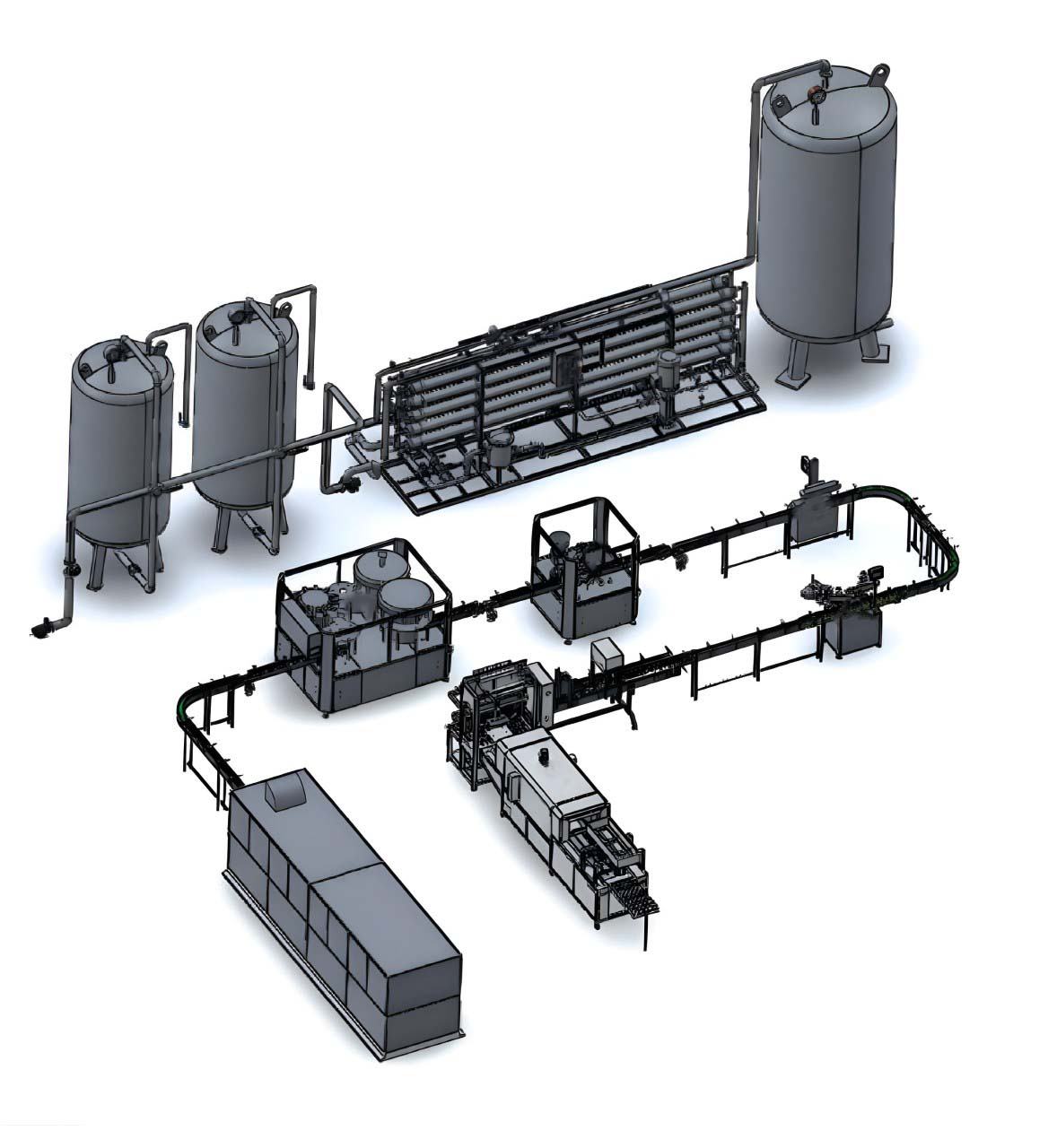
A complete packaged drinking water plant 3000 LPH setup isn't just one machine — it's a line. Each stage feeds into the next, and a mismatch in capacity at any point creates a bottleneck that limits the entire plant's output.
- RO Purification System (2,000–20,000 LPH): The treatment core — pressure sand filter, activated carbon filter, absolute micron cartridge filters (MCF), reverse osmosis membrane, anti-scalant dosing, UV steriliser, ozone generator, product water storage tank, and high-pressure pump. For a 3000 LPH plant, an entry-level RO system is configured to treat your source water and feed the filling line without interruption. Aim Technologies' RO plants start at 2,000 LPH and scale to 20,000 LPH, with Added Mineral Technology available across the range.
- Water Filling Machine (30–200 BPM): Aim Technologies' filling machines are mono block rotary units — rinsing, filling, and capping happen in one compact machine. For a 3000 LPH plant, the 40 BPM model is the exact configuration match: 8 rinsing heads, 8 filling heads, 4 capping heads, 3 KW power consumption. Key specs: no-bottle-no-fill sensor eliminates waste and protects hygiene, non-contact bottle counters, separate cap elevator, and all water-contact parts in SS316L with the remaining structure in SS304. The 40 BPM model fits comfortably within Aim Technologies' turnkey range of 40 BPM to 200 BPM and leaves a clear upgrade path to 60 BPM, 90 BPM, or 120 BPM as your distribution volume grows.
- PET Blowing Machine (900–12,000 BPH): Aim Technologies manufactures PET blowing machines from 2 KVT (1,000 BPH) to 6 KVT (12,000 BPH), handling bottles up to 1,500 ML and max height of 360 MM. For a 3000 LPH (40 BPM) plant, the 4 KVT model (3,000 BPH, 300 MM max height, 33 KW) is the right match — it produces your own bottles in-house at a pace that fully keeps up with the 40 BPM filling line, cuts packaging cost, and gives you complete control over bottle weight and design. Running your own blowing machine eliminates dependence on external preform suppliers and the price volatility that comes with it. It's optional at startup if you prefer to source bottles initially, but the cost savings in Year 2 typically justify the upfront investment.
- Labeling Machine: Your label is the only point of contact your brand has with the end consumer at retail. Aim Technologies manufactures two types relevant for water plants. The Sticker Labeling Machine features a 7-inch touch screen HMI (MITSUBISHI/DELTA), multiple programme storage for quick format changes, total count output records, and fully operator-free running. The BOPP Labeling Machine (60–200 BPM) uses SS304 construction, a vacuum system, PLC control, and a no-bottle-no-label mechanism that prevents label waste. For a 3000 LPH (40 BPM) plant, the BOPP Labeling Machine in the 60–100 BPM range is the practical choice — it comfortably exceeds the filling line's 40 BPM speed, ensuring the labeling stage never becomes the production bottleneck.
- Shrink Wrapping Machine: Groups bottles into retail packs (6-pack, 12-pack) with tamper-evident shrink film — required for BIS-compliant outer packaging. For a 3000 LPH (40 BPM) plant, the 90 BPM Automatic Shrink Wrapping Machine (8 packs/min, 25 KW, 12 CFM, 200–2,000 ML) is the right match. At 40 BPM filling speed, you produce approximately 40 bottles per minute; grouped in 6-packs, that's roughly 7 packs per minute — the 90 BPM auto at 8 packs/min keeps up without creating a downstream backlog. Key components: Janatics pneumatics, L&T electrical switches and MCBs, SS304 conveyor, ROTOMOTIVE motors, and DELTA/MITSUBISHI/VEICHI servo drives. See our semi-automatic vs fully automatic shrink wrapping guide for help choosing.
- Batch Coding Machine: Required for printing manufacture date, expiry date, batch number, and BIS licence number on every bottle — a legal requirement under IS 14543 labelling rules. Aim Technologies supplies two variants: the Ink Jet model (easy to use, suitable for a wide range of applications, high-speed printing, low investment, easy maintenance) and the Laser Jet model (maintenance-free, no consumable, high-speed coding, eco-friendly). For a 3000 LPH plant at startup, the Ink Jet coder is the practical first choice — low investment, easy maintenance, and high-speed printing suited to a 40 BPM line. The Laser Jet model is worth considering if you want a zero-consumable, maintenance-free setup from Day 1.
Mistakes That Kill ROI Before You Even Start
The machinery quote is the most visible cost — it's not the total cost. Civil works, drainage, electrical upgrades, laboratory equipment, working capital for the first three months, and licensing fees together often exceed the machinery cost itself. Build a complete DPR (Detailed Project Report) before you commit.
You cannot legally sell packaged drinking water in India without the BIS ISI mark. No major retailer or distributor will stock your product without it. Starting production before the licence is received means storing inventory that can't be sold — a cash flow trap that has ended early-stage plants.
A 3000 LPH plant is a strong growth-stage plant if you have a credible distribution plan for the output. If you're still figuring out how to reach retailers, start with the distribution model first. Production capacity you can't sell is just depreciation.
RO systems, filling machines, and PET blowing machines all carry real power loads. For reference based on Aim Technologies' specifications: a 4 KVT PET blowing machine runs at 33 KW; a 40 BPM filling machine at 3 KW; a 90 BPM Automatic Shrink Wrapping Machine at 25 KW. Combined, even a 3000 LPH (40 BPM) production line needs a reliable 3-phase industrial connection sized for the full simultaneous load. Combined, a 3000 LPH production line needs a reliable 3-phase industrial connection. In areas with unstable grid supply, a generator sized to run the entire production line simultaneously — not just the RO pump — is essential. Many first-time operators budget for the machines but not the electrical infrastructure, transformer upgrades, or generator capacity to run them reliably.
Frequently Asked Questions
Ready to Start Your Mineral Water Plant?
Get a complete equipment list, project guidance, and a free quote from Aim Technologies. We supply turnkey 3000 LPH mineral water plant packages across India and internationally — including BIS/ISI consultancy.
Related Articles
🏭 Planning a Mineral Water Plant?
Get a complete equipment list and free project quote from Aim Technologies.
📱 WhatsApp Now