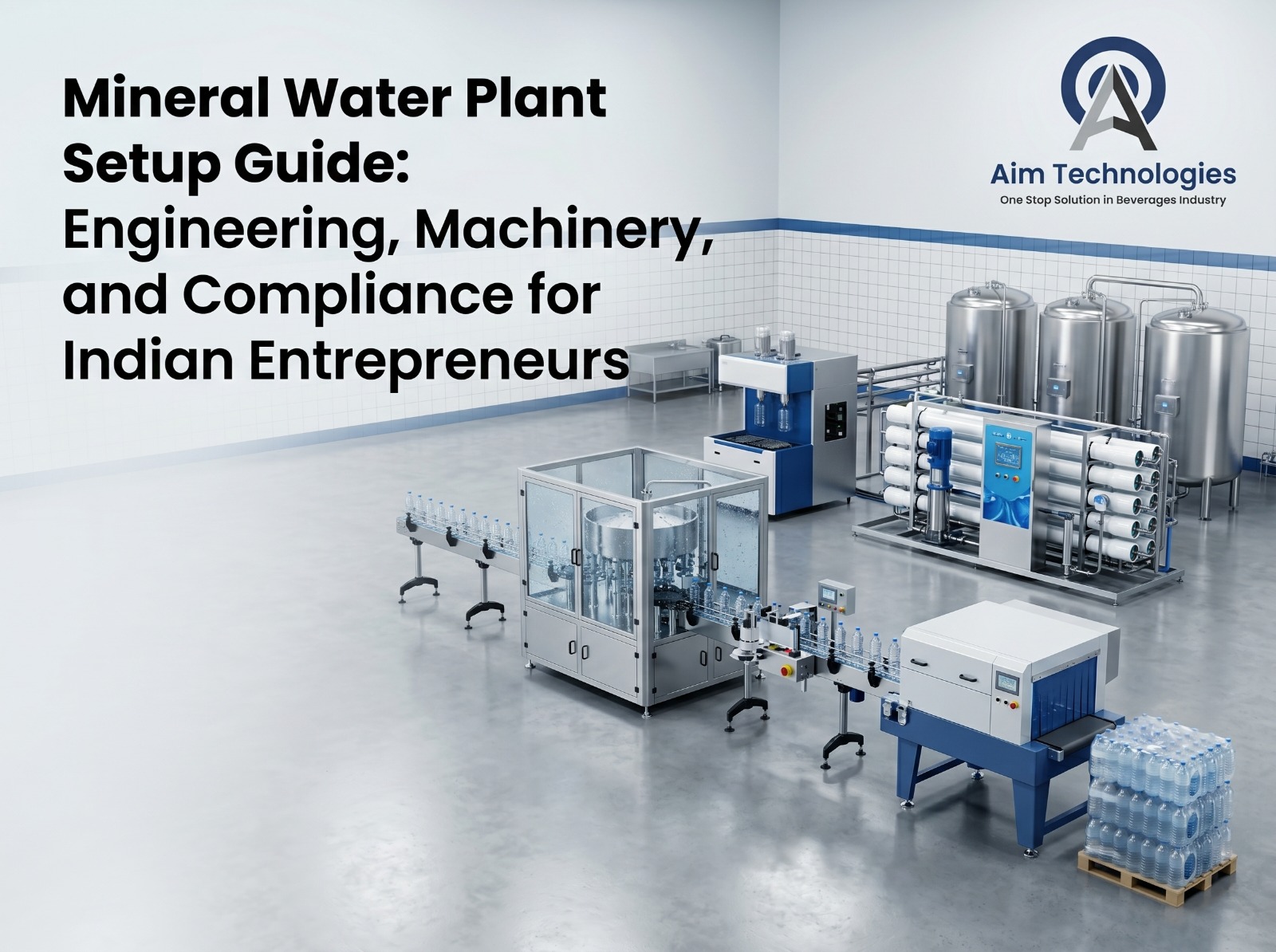
There's a moment every new packaged water entrepreneur hits — usually after three or four conversations with machinery sellers — where the information starts to blur. Every vendor claims their system is the best. Everyone quotes a different process. And somewhere in the middle of all that, the actual setup picture becomes harder to see, not easier.
This mineral water plant setup guide is written for that moment.
It covers the engineering side, the machinery you actually need, the compliance reality in India, and the order in which things should happen. It's based on what's genuinely required — not on what sounds impressive on a product page.
Aim Technologies has been manufacturing and supplying complete turnkey mineral water plant packages since its establishment in Surat, Gujarat. We're ISO and CE certified. And we've worked with plant owners across India and internationally. So what follows is grounded in real experience, not theory.
Most people approach a plant setup in the wrong order. They compare machines, get quotes, and then worry about the water source. That's backwards.
The single biggest variable in your entire operation is the quality of your raw water. Hard water requires different treatment than soft water. Water with high dissolved solids needs a different RO configuration. Water from a borewell behaves differently than water from a municipal connection or a river source.
Before you commit to any machinery — including the RO system — get your raw water tested by a government-approved laboratory. The test results tell you exactly what your treatment system needs to do. Without that data, any machinery quote you receive is essentially a guess.
This step also matters for your BIS application. The Bureau of Indian Standards requires water test reports as part of the certification process. If you're going to need them anyway, it's far smarter to generate them at the start of the project rather than near the end.
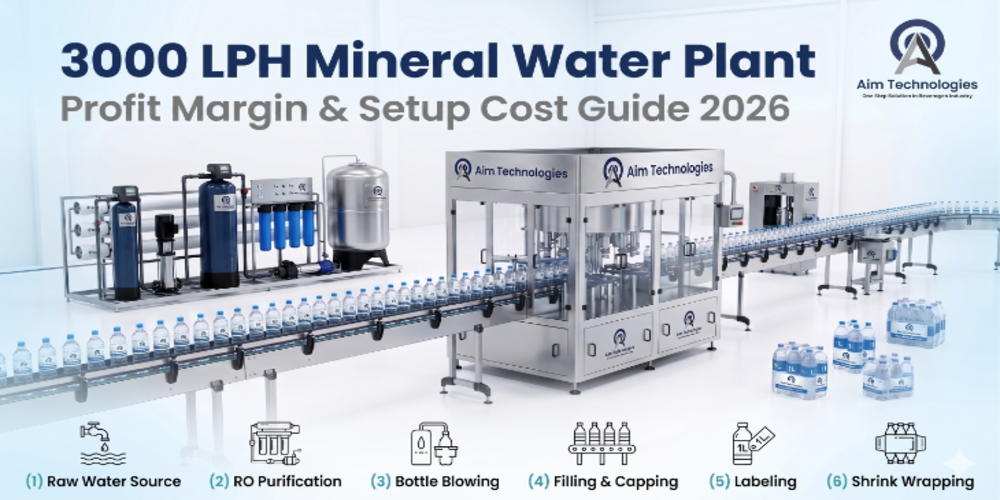
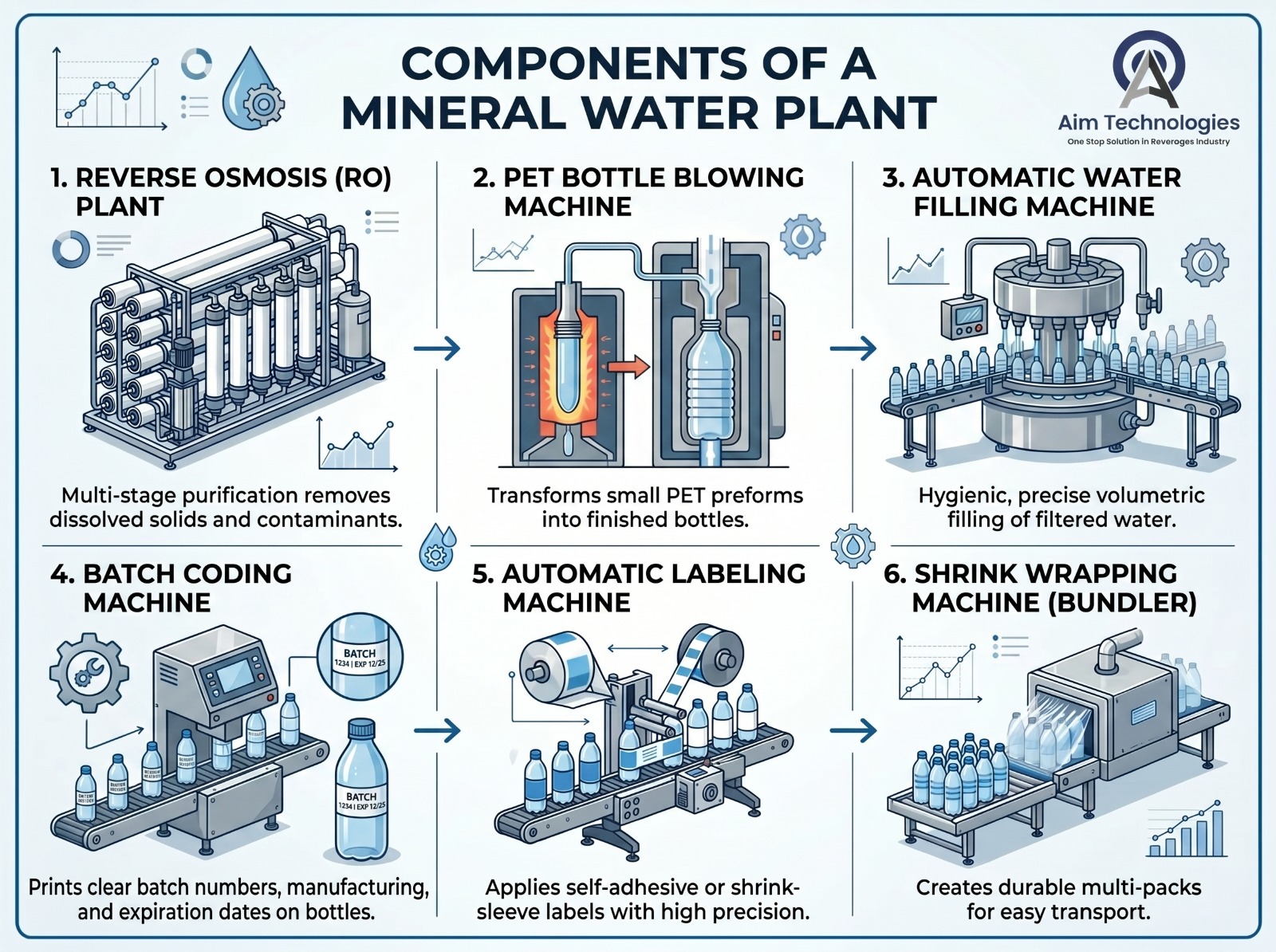
The RO plant is the core of any packaged drinking water setup. It's what transforms raw water from your source into a product that meets the quality standards required for commercial bottling.
The process runs in stages, and each stage has a specific job.
Raw water enters a sand filter first, which removes suspended particles — the visible debris, sediment, and turbidity that comes with any ground or surface water source. From there it moves through an activated carbon filter, which handles chlorine, organic compounds, and anything that affects taste or odour.
The process runs in stages, and each stage has a specific job.
Then comes the RO membrane. This is where the serious work happens. The membrane operates under pressure, forcing water through a semi-permeable surface that holds back dissolved solids, heavy metals, bacteria, and most chemical contaminants. The resulting water is stripped of impurities, but it's also stripped of minerals — which is why the next steps matter.
After RO, the water passes through a UV sterilisation unit, which uses ultraviolet light to neutralise any remaining microbial activity. Bacteria and viruses that somehow survived the membrane treatment don't survive UV exposure. Following UV, an ozone generator provides a final layer of protection, keeping the water sterile inside the bottle throughout its shelf life.
Aim Technologies supplies RO systems scaled to the specific production needs of each plant — whether that's a compact setup for a small local brand or a high-output system for a multi-shift commercial operation. The capacity of your RO system should be matched to your filling line from day one, not added to later. Mismatched capacity between treatment and bottling is one of the most common and most avoidable production problems we see.
Once the water is treated, it moves into the bottling line. And this is where a lot of first-time plant owners underestimate the complexity.
A bottling line isn't a single machine. It's a sequence of machines, each with its own speed, its own requirements, and its own potential to become a bottleneck if it isn't matched correctly to the others.
The first stage is bottle production or bottle supply. If you're manufacturing your own PET bottles on-site, you'll need a PET blowing machine. Aim Technologies manufactures both semi-automatic and fully automatic PET blow moulding machines, with production capacities ranging from smaller operations all the way up to high-volume continuous runs. Making your own bottles on-site has real advantages — you eliminate the logistics cost of storing large quantities of empty bottles, you reduce the contamination risk that comes from bottles sitting in storage, and you have control over bottle shape and wall thickness.
For startups where capital is tight, sourcing pre-formed bottles externally is a reasonable way to begin. But most serious operators move toward in-house bottle production relatively quickly once volumes justify the investment.
After bottles are produced, they enter the filling machine. This is the heart of the bottling line in terms of hygiene. The filling machine from Aim Technologies handles rinsing, filling, and capping as an integrated process — the bottle is inverted and cleaned with treated water, filled to precise volume, then capped in a sealed, enclosed environment. The importance of that enclosed environment is hard to overstate. Any gap between filling and capping introduces contamination risk, and that risk is what BIS auditors look for during inspections.
Aim Technologies water filling machines are available across a range of output speeds to match different production scales, from smaller operations running a single shift to high-volume plants running around the clock.
People don't buy water. They buy a bottle they trust. And the label is what creates that trust at the point of sale.
This sounds like a marketing observation, but it has engineering implications. Label placement accuracy, adhesion quality, and consistency across thousands of bottles per day are production problems, not just aesthetic ones. A label that peels, sits crooked, or bubbles on a wet bottle sends an instant signal to a retailer that the operation behind it isn't professional.
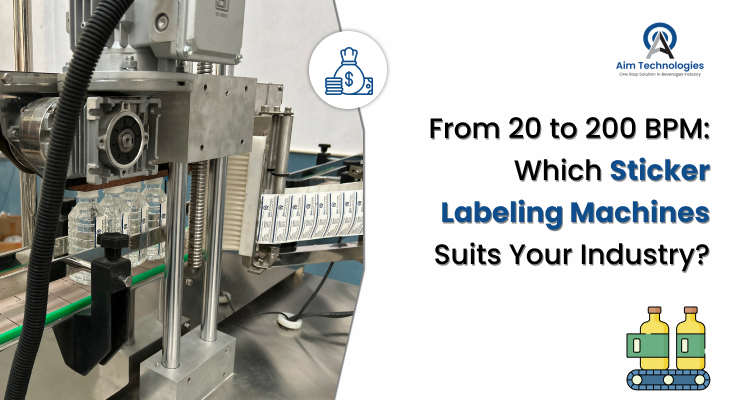
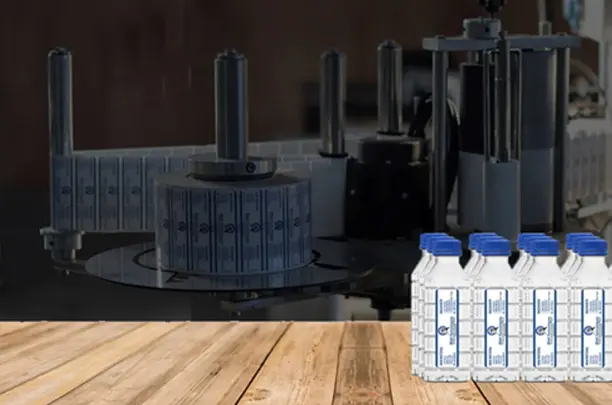
Aim Technologies manufactures a full range of labeling machines to suit different bottle types and production speeds. The product range includes single-side sticker labeling machines for flat bottles, front and back sticker labeling machines for bottles requiring branding on both faces, round labeling machines specifically designed for cylindrical water bottles, BOPP labeling machines for high-gloss film labels, shrink sleeve applicators for full-body label coverage, and all-in-one labeling machines for operations handling multiple label formats.
The right machine depends on your bottle shape, your label type, and your production speed. Getting that match right matters because a labeling machine that can't keep pace with your filling machine creates a bottleneck at the end of the line — and that means your faster, more expensive upstream machines are waiting on the slower downstream one.
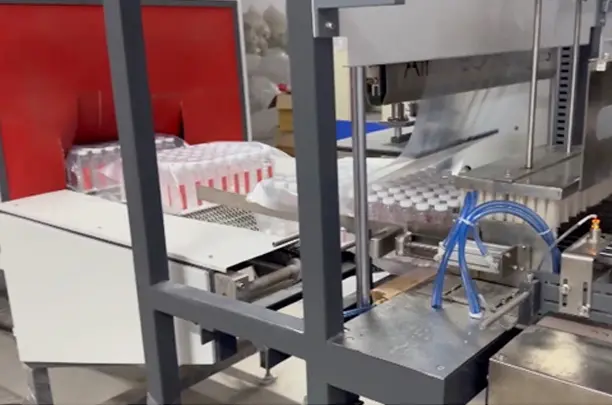
Once labelled, bottles need to be grouped into retail packs and outer-bundled for transport. This is what the shrink wrapping machine handles.
Shrink wrapping isn't just packaging. For packaged drinking water sold in India, the outer shrink wrap on a retail multipack serves as tamper evidence — and tamper evidence is a BIS compliance requirement for IS 14543 certified products. So this isn't an optional finishing step. It's a regulatory one.
Aim Technologies manufactures shrink wrapping machines in both semi-automatic and fully automatic configurations, with output speeds ranging from lower-volume semi-automatic models all the way up to the high-speed linear shrink wrapping machine for large-scale operations.
The choice between semi-automatic and fully automatic depends on your production volume and your labour cost calculation. Semi-automatic machines require an operator at each cycle and offer more flexibility for varied pack formats. Fully automatic machines run continuously, reduce labour per unit, and are the right choice when your filling machine output outpaces what manual packaging can sustain.
The critical rule — and it's the same rule that applies across every machine in the line — is that your shrink wrapping machine's throughput must match your filling machine's output. Every mismatch creates a bottleneck, and every bottleneck reduces the effective output of your entire plant.
Let's be direct about this part, because there's a lot of confusing and occasionally outdated information circulating.
To legally sell packaged drinking water in India, you need both BIS certification and an FSSAI licence. They're not alternatives. They're independent requirements that cover different things.
The BIS certification — specifically the ISI mark issued under IS 14543 for packaged drinking water — governs the quality of the water itself. The Bureau of Indian Standards sets the technical requirements the water must meet. Getting the ISI mark involves applying to BIS, having your water tested at an approved independent laboratory, establishing an in-house laboratory at your plant, and passing a factory inspection where BIS officials verify that your facility and processes meet the standard.
The in-house laboratory is where many first-time applicants get caught off guard. BIS requires that you have a functioning, equipped laboratory capable of conducting all the physical, chemical, and microbiological tests prescribed under the relevant Indian Standards. This lab needs to be in place before the factory inspection — not planned for afterward. And it needs to be run by qualified chemists or microbiologists, not general factory staff.
The FSSAI licence is separate. It covers food safety and facility hygiene under the Food Safety and Standards Act. FSSAI has classified packaged drinking water as a High-Risk Food Category, which means the compliance requirements are more detailed than for general food products. The level of FSSAI licence you need — basic, state, or central — depends on your annual turnover and the scale of your operation.
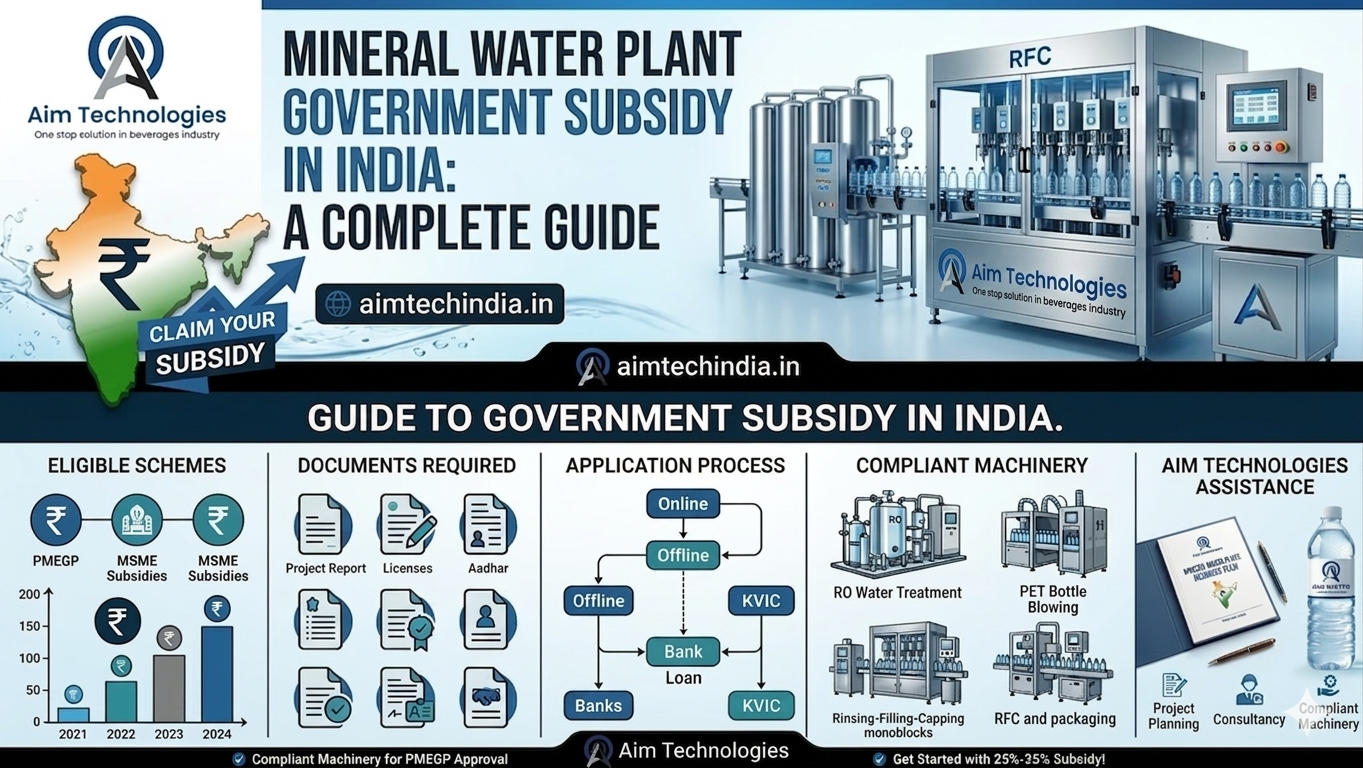
Beyond BIS and FSSAI, you'll also need a Pollution Control Board NOC for your state, a groundwater permission if you're drawing from a borewell, a factory licence, and GST registration. None of these are optional, and the timeline for each varies by state.
Aim Technologies provides BIS and ISI consultancy services to plant owners going through this process. The consultancy covers plant layout design, documentation support, and preparation for the factory inspection. Getting your plant layout right from the beginning — rather than redesigning it to meet BIS requirements later — saves considerable time and money.
A turnkey mineral water plant means a single supplier is responsible for the entire system — from the raw water intake through to finished, packaged product rolling off the line. You don't coordinate between a separate RO vendor, a separate filling machine vendor, and a separate packaging vendor. One company handles the specification, supply, installation, and commissioning of the complete line.
Aim Technologies supplies complete turnkey mineral water plant packages. The package covers the RO purification system, the water filling machines, the PET blowing machine, labeling machine, shrink wrapping machine, and BIS/ISI consultancy — plus on-site installation and operator training once the machinery is commissioned.
The advantage of turnkey isn't just convenience. It's accountability. When every machine in your line comes from one supplier, there's no ambiguity about whose responsibility a problem is. Incompatible throughput speeds between machines, integration issues at handover points between stages, or commissioning delays — these are all the supplier's problems to solve, not yours to manage between three or four different vendors.
That said, turnkey isn't always the right choice. If you already have certain equipment, or if your setup is highly specific in ways a standard package doesn't cover, a modular approach where you source certain components separately can be the better path. The honest answer is: it depends on your situation. The right question to ask any supplier — including us — is not "do you offer turnkey?" but "can you show me plants of a similar scale that you've commissioned, and can I speak to those operators?"
This is the part of the conversation that doesn't happen enough.
Machines arriving on-site is not the same as a plant being ready to operate. Installation takes time. Commissioning — the process of bringing each machine online, calibrating it, running test batches, and verifying that the full line runs correctly end-to-end — takes more time. And the first weeks of production, when your operators are still building familiarity with the equipment, are the weeks when misuse and minor errors are most likely.
Aim Technologies provides on-site installation and operator training at every client facility as part of the supply package. That includes calibration, test runs, and practical training for the staff who'll be running the line day-to-day. It also includes after-sales support for the period after commissioning — because questions that don't come up during training often surface in the first month of real production.
After-sales support isn't a luxury in this business. Your plant running is what generates revenue. Every day it doesn't run because of an unresolved maintenance issue is a day of lost production. Make sure, before you sign any purchase agreement, that the support terms are clearly defined — not vague promises about being "available."
A few patterns show up repeatedly among operators who struggle in the first year.
The first is treating the machinery quote as the total project cost. It isn't. Civil works — factory flooring, drainage, electrical infrastructure for industrial-grade power supply, storage tanks, plumbing — these can collectively exceed the cost of the machinery itself. Budget for the complete project, not just the equipment line items.
The second is starting production before the BIS licence is secured. It seems obvious, but the pressure to start generating revenue leads some operators to begin bottling before certification is in place. You can't legally sell packaged drinking water without the ISI mark. Retailers won't stock it. Distributors won't touch it. And if an inspector visits, the consequences are serious.
The third — and this one is specifically about the machinery — is choosing machines for their lower price without verifying that their throughput is compatible with the rest of your line. A cheaper filling machine that runs at a speed your shrink wrapping machine can't keep up with doesn't save you money. It creates a production bottleneck that limits the output of your entire plant, and you end up replacing it within a year anyway.
And the fourth is not having a distribution plan before the plant opens. This isn't an engineering problem, but it's the most common reason plant owners don't break even when they expected to. If you haven't established relationships with retailers, distributors, hotels, institutions, or whoever your actual buyers will be before you start production, you'll be selling into a vacuum. Build the market before you build the line.
A. A turnkey mineral water plant is a complete packaged drinking water production system supplied, installed, and commissioned by a single manufacturer. It covers the entire production process — from raw water intake and RO purification through filling, blowing, labeling, and shrink wrapping — so you're not coordinating between multiple vendors. Aim Technologies supplies complete turnkey mineral water plant packages including BIS consultancy and on-site training.
A. A complete line typically includes an RO purification system, a water filling machine that handles rinsing, filling, and capping, a PET blowing machine if you're producing bottles on-site, a labeling machine suited to your bottle type, and a shrink wrapping machine for retail multipacks. Each machine's output speed must be matched to the others in the line to avoid bottlenecks.
A. BIS certification under IS 14543 is the legal standard for packaged drinking water in India. You also need an FSSAI licence, a Pollution Control Board NOC, a groundwater permission if you're using a borewell, and a factory licence. Both BIS and FSSAI are independently required — one doesn't substitute for the other.
A. A PET blowing machine produces the plastic bottles from PET preforms on-site, immediately before filling. This eliminates the need to store large quantities of empty bottles, reduces contamination risk from stored bottles, and gives you control over bottle design and specifications. Aim Technologies manufactures semi-automatic and fully automatic PET blow moulding machines for all production scales.
A. The water filling machines handles three operations in sequence — rinsing the bottle with treated water, filling it to the precise required volume, and sealing it with a cap — all within a closed, hygienic environment. The enclosed process is a BIS requirement because it minimises contamination between filling and capping. Aim Technologies supplies water filling machines across a range of output speeds.
A. The right labeling machine depends on your bottle shape and label type. Round water bottles typically use a round labeling machines. Flat bottles use a single-side or front and back labeling machine. BOPP film labels need a dedicated BOPP labeling machine. Shrink sleeve labels require a shrink sleeve applicator. Aim Technologies manufactures all of these types and can recommend the right option for your specific bottle and production speed.
A. Yes. Aim Technologies provides BIS and ISI consultancy as part of the turnkey mineral water plant package. This includes plant layout design to meet BIS standards, documentation support, and preparation for the factory inspection. Getting the layout right before the inspection — rather than modifying it afterward — saves substantial time in the certification process.

Subscribe To Our Newsletter to get the latest news, updated and amazing offers delivered directly in your inbox.
For More Details Call Us :