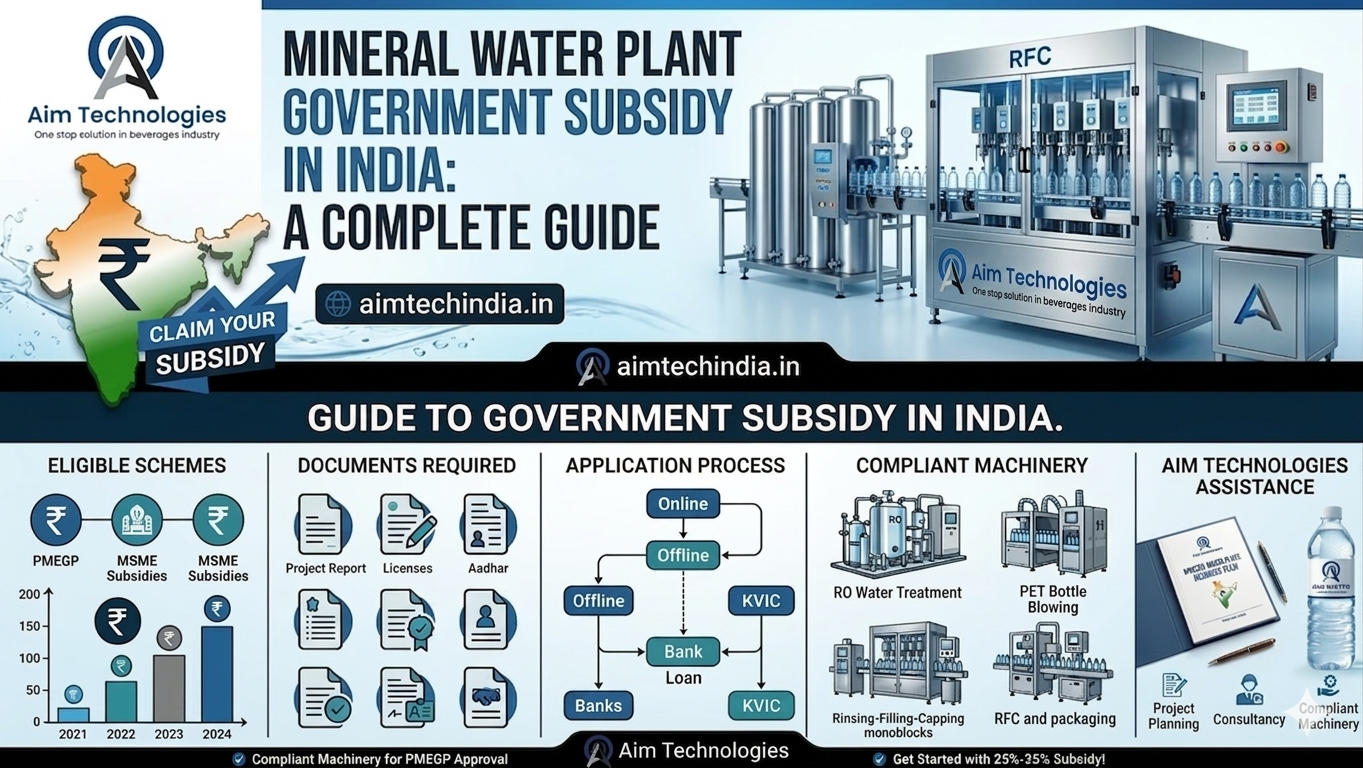
If you're thinking about starting a mineral water plant in India, one of the first questions that comes up is money — how much it costs, where to arrange it, and whether the government has anything to offer. The good news is that it does. Quite a bit, actually.
India's packaged drinking water industry has been growing steadily for over a decade. With growing concerns about tap water quality, more health awareness among consumers, and fast urbanization in Tier-2 and Tier-3 cities, the need for safe bottled water will not decrease anytime soon. The government has taken note of this — and that's exactly why multiple subsidy schemes, soft loans, and financial incentives exist for entrepreneurs who want to enter this space.
Whether you're a first-time entrepreneur with a small budget, an existing food business owner looking to diversify, or someone from a rural area exploring manufacturing options — there is something in this guide for you. We've covered every major central government scheme, state-level incentive, and practical step you need to know, all in plain language without any confusion.
India's packaged drinking water market is one of the fastest-growing food & beverage segments in the country. Demand has been climbing for years — thanks to urbanisation, poor tap water quality in many cities, and growing health awareness. The government knows this and has created several schemes to help small and medium entrepreneurs enter this space.
If you're planning to set up a mineral water or packaged drinking water (PDW) plant, you don't have to fund everything from your own pocket. There are subsidies, collateral-free loans, capital subsidies, interest subventions, and tax benefits available — if you know where to look and how to apply.
Yes — and the short answer is: quite easily, actually. A mineral water or packaged drinking water plant typically falls under food processing or agro-processing industries under government classification. This makes it eligible for multiple central and state government schemes.
The key categories your business fits into:
Quick Fact: Under the MSME definition (revised 2020), a manufacturing unit with investment up to ₹50 crore and turnover up to ₹250 crore qualifies as a Medium Enterprise. Most water plants fall well within the Small or Micro category — making them eligible for maximum MSME benefits.
This is probably the most well-known scheme for first-time entrepreneurs. PMEGP gives you a capital subsidy directly on your project cost — meaning a portion of the loan doesn't have to be repaid.
For a water plant with a project cost of ₹30 lakhs, you're effectively getting ₹7.5 to ₹10.5 lakhs as a free subsidy. That's significant working capital saved right from Day 1. PMEGP is implemented through KVIC (Khadi and Village Industries Commission), KVIB at the state level, and District Industries Centres (DICs). You apply online at the official PMEGP portal.
One of the biggest problems new entrepreneurs face is collateral. Banks ask for property or assets as security, and many first-time business owners don't have that. CGTMSE solves this. Under this scheme, the government provides a credit guarantee to the bank — so the bank can give you a loan without asking for collateral.
If your water plant project cost is under ₹2 crore, you should specifically ask your bank about CGTMSE coverage when applying for the loan.
This scheme is specifically for food processing units — and packaged drinking water qualifies. It was launched in 2020 with an outlay of ₹10,000 crore over 5 years.
If you already have a small water business operating informally and want to upgrade your machinery, get BIS/ISI certification, and expand — PMFME is a very useful scheme.
The PLI scheme gives you cash incentives based on your production growth. It's more relevant for larger companies, but if you're planning a significant scale-up, it's worth tracking.
Small Industries Development Bank of India (SIDBI) offers several financing products designed specifically for MSMEs. These include direct loans, refinance through banks, and equity support.
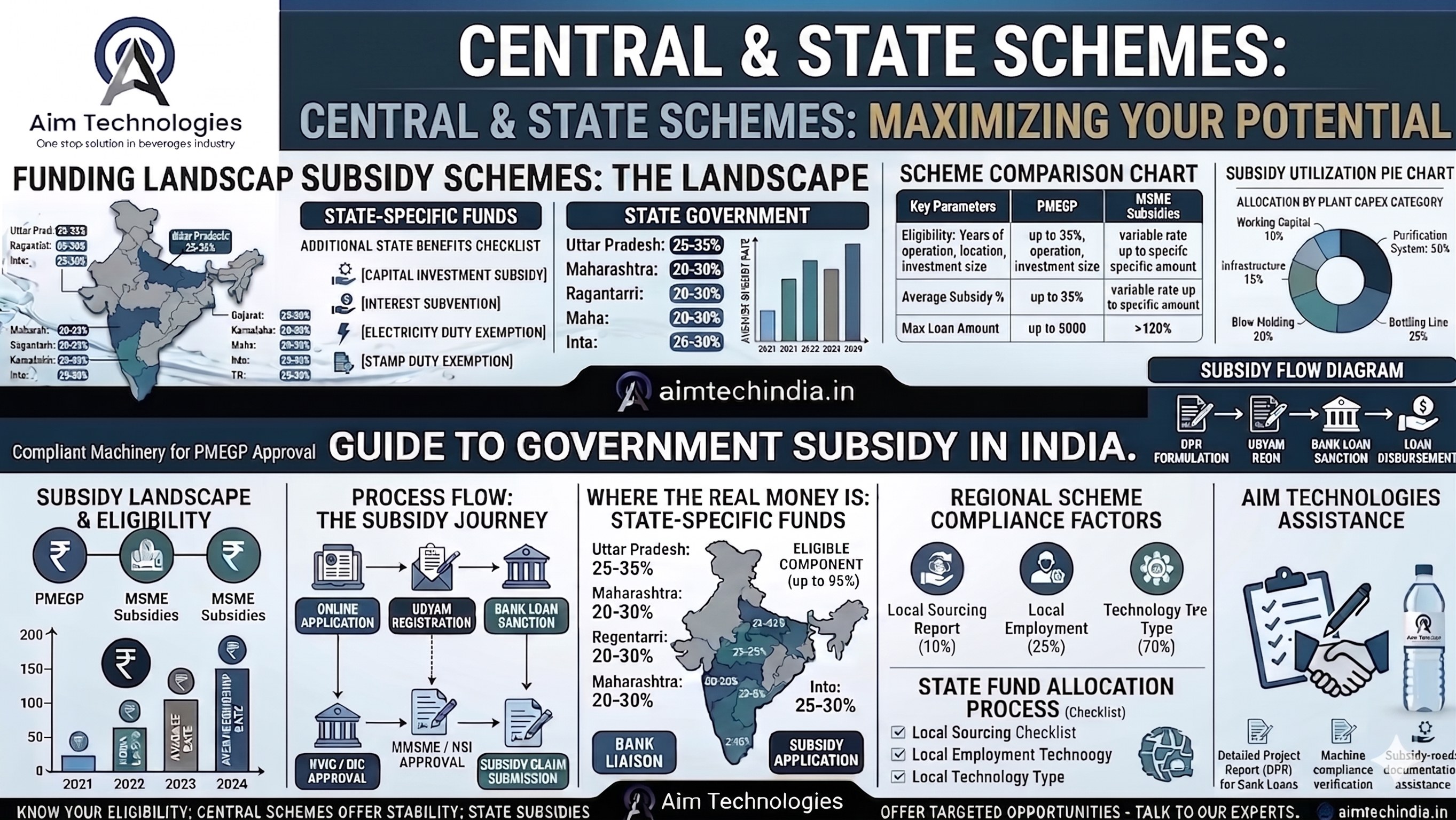
Honestly, state-level schemes are where many smart entrepreneurs find the biggest benefits. Most states have their own industrial policy that offers additional subsidies on top of central schemes. Here's a state-wise snapshot of common benefits — keep in mind these change with each new industrial policy, so verify the current version with your state's Industries Department or DIC:
| State | Key Benefits Available |
|---|---|
| Maharashtra | 25–30% capital subsidy for food processing, power tariff subsidy, stamp duty exemption, 5-year SGST refund for eligible units in backward areas |
| Gujarat | Capital subsidy up to 25% under MSME policy, interest subsidy 5–7%, electricity duty exemption for 5 years |
| Uttar Pradesh | One District One Product (ODOP) benefits, 25% capital subsidy, loan at 4% interest for women entrepreneurs |
| Rajasthan | Interest subsidy 5–7%, capital subsidy 25–30% in Category B/C districts, electricity bill rebate |
| Tamil Nadu | TIDCO/SIPCOT land at subsidised rates, power cost reimbursement, 15% capital subsidy for MSMEs |
| Madhya Pradesh | Capital subsidy 15–40% depending on location, electricity duty waiver, stamp duty exemption |
| Uttarakhand / HP | Higher central subsidies + state top-ups (hilly region benefits), 30–50% capital subsidy in some cases |
| Jharkhand / Odisha | Tribal area incentives, additional employment generation benefits, raw material support |
The general rule of thumb: the more backward or remote the location, the higher the subsidy. If you're willing to set up in a Tier-2 or Tier-3 town or a designated industrial area, you'll often get significantly better incentives than in a metro.
A lot of people confuse these two. Here's a clear breakdown:
| Type | What It Means | When You Get It |
|---|---|---|
| Capital Subsidy | A one-time grant on your total project investment (machinery, civil work, etc.) | After project completion and bank disbursement — upfront relief on capital cost |
| Interest Subsidy | Government pays part of your loan interest on your behalf | Every year for a fixed period (usually 5–7 years) as long as you repay the loan regularly |
| Working Capital Subsidy | Support for day-to-day operational expenses — raw materials, packaging, etc. | Some state schemes offer this separately, especially for food processing units |
Ideally, you want both. Apply for capital subsidy under PMEGP or state policy, and then check if your bank loan qualifies for interest subvention under any separate scheme.
Before applying to any scheme, get your Udyam Registration done. It's free, done entirely online, and takes less than 30 minutes if you have your Aadhaar and PAN ready. The Udyam certificate proves your MSME status to banks, government departments, and subsidy bodies. Without it, you won't be eligible for most of the schemes discussed above.
Go to: https://udyamregistration.gov.in/
Documents needed: Aadhaar number of proprietor/partner/director, PAN of business, business address, bank account details, NIC code for your activity (NIC 11050 for mineral water / packaged drinking water).
Here's how the typical PMEGP process works for a mineral water plant:
The full process typically takes 3 to 6 months. The biggest delay usually happens at the DPR stage — so get a proper consultant or CA to help you draft a solid project report.
Pro Tip: Banks are more likely to process your PMEGP loan quickly if you approach them with a complete file — including BIS certification plan, machinery quotations, land/lease documents, and your Udyam certificate. Incomplete files sit on the desk for months.
The government won't just hand out subsidies to unregistered units. You'll need these in place (or at least in process) before or alongside your subsidy applications:
| Licence / Certificate | Issuing Authority | Why It's Needed |
|---|---|---|
| BIS Certification (IS 14543) | Bureau of Indian Standards | Mandatory for packaged drinking water — no BIS, no business legally |
| FSSAI Licence | Food Safety & Standards Authority of India | Required for all food/beverage businesses — Central licence if turnover > ₹20 crore |
| Factory Licence | State Labour / Factory Dept. | Needed once you have a certain number of workers |
| NOC from Pollution Control Board | State PCB | Water treatment involves waste; you need environmental clearance |
| Water Extraction Permission | State Groundwater Authority | If you're drawing groundwater, a No Objection Certificate is mandatory |
| Trade Licence / Shops & Est. | Municipal Corporation | Basic operational licence for your business premises |
| GST Registration | GSTIN Portal | Mandatory once turnover crosses threshold; also needed for input tax credit |
Having these licences in order also makes you look more credible to banks — which speeds up loan and subsidy approvals.
The government actively promotes entrepreneurship among certain groups, and the water plant business is no exception.
Women Entrepreneurs:
SC/ST Entrepreneurs:
Rural / Remote Area Units:
| Purpose | Portal / Contact |
|---|---|
| PMEGP Application | kviconline.gov.in/pmegpeportal |
| Udyam (MSME) Registration | udyamregistration.gov.in |
| SIDBI MSME Loans | sidbi.in |
| FSSAI Licence | foscos.fssai.gov.in |
| BIS Certification (IS 14543) | manakonline.in |
| MOFPI Schemes (PMFME, PLI) | mofpi.gov.in |
| CGTMSE Info | cgtmse.in |
| State DIC (District Industries Centre) | Your state's Industries Dept. website |
| Startup India (if applicable) | startupindia.gov.in |
| Phase | Timeline | Key Activities |
|---|---|---|
| Planning & Registration | Month 1–2 | Business plan, Udyam registration, DPR preparation, site selection |
| Licences & Approvals | Month 2–4 | FSSAI application, PCB NOC, factory licence, BIS application |
| PMEGP / Bank Application | Month 2–4 | Submit PMEGP application, bank approach, task force interview |
| Sanction & Construction | Month 4–8 | Loan sanction, civil work, machinery order, infrastructure setup |
| Installation & Testing | Month 7–10 | Machinery installation, trial runs, BIS lab testing |
| Commercial Launch | Month 10–14 | Full production, marketing, distribution setup |
| Subsidy Credit | Month 12–18 | After verification by bank/KVIC, subsidy credited to loan account |
A. Yes, most central schemes like PMEGP don't require prior business experience. What matters more is a solid Detailed Project Report (DPR), your educational or vocational background, and how clearly you can explain your business plan during the interview. Attending an EDP (Entrepreneurship Development Programme) — which PMEGP actually requires — also helps.
A. There's no official minimum, but practically speaking, banks don't find it viable to process loans below ₹5–10 lakhs. Most mineral water plant projects come between ₹15–50 lakhs for small units, which is well within the PMEGP limit of ₹50 lakhs for manufacturing.
A. The subsidy is calculated as a percentage of your total project cost — not just the loan amount. For example, if your total project cost is ₹30 lakhs and you're eligible for 25% subsidy, you get ₹7.5 lakhs. This amount is kept in a 'subsidy reserve account' with the bank for 3 years. After the lock-in period (and if you've run the business without default), it gets adjusted against your principal loan.
A. Not a specific 'machinery-only' subsidy for RO plants. But within the overall project cost under PMEGP, PMFME, or state capital subsidy schemes, machinery cost is definitely included in the eligible project cost. So your RO plant, UV system, ozonation unit, and bottling machinery all count toward the capital subsidy base.
A. This varies by state. Some states explicitly allow stacking — meaning you can get the central PMEGP subsidy AND the state capital subsidy for the same project. Others have a cap or exclusion clause. Always check with your DIC office before assuming you can combine them. In states like Uttar Pradesh and Maharashtra, many entrepreneurs have successfully combined both.
A. This happens more than it should. Start by approaching the MSME-dedicated branch of nationalised banks like SBI, Bank of Baroda, or Canara Bank. If a branch is unresponsive, escalate to the Lead District Manager (LDM) of your district or file a complaint through the PMEGP portal. You can also approach the KVIC/KVIB office directly — they can follow up with the bank on your behalf.
A. Yes. MOFPI classifies packaged drinking water and natural mineral water as food products under the Food Safety and Standards Act. This makes your plant eligible for PMFME, PLI, and other MOFPI schemes. Make sure your FSSAI product category is correctly specified when applying.
A. Central schemes like PMEGP are generally for Indian citizens residing in India. Foreign nationals and NRIs typically cannot apply directly for PMEGP. However, NRIs can set up a company in India (Pvt Ltd or LLP) with Indian co-founders and explore SIDBI or bank financing. Some states have separate NRI entrepreneur policies — worth checking your state's industrial policy.
A. Yes, packaged water in bottles above 20 litres attracts 12% GST, while smaller bottles (up to 20L) attract 18% GST as of current slabs (though these can change — always verify). This doesn't directly affect subsidy calculations, but it does affect your pricing and working capital needs. Make sure your DPR accounts for GST in the financial projections.
A. Start with your nearest District Industries Centre (DIC) — they have free advisory services. KVIC and KVIB also conduct workshops. For paid consultants, look for those who have specifically handled food processing or MSME project reports. Ask for past examples of approved DPRs. A good DPR writer typically charges ₹15,000 to ₹50,000 depending on project complexity — money well spent if it helps your ₹7–15 lakh subsidy get approved.

Subscribe To Our Newsletter to get the latest news, updated and amazing offers delivered directly in your inbox.
For More Details Call Us :