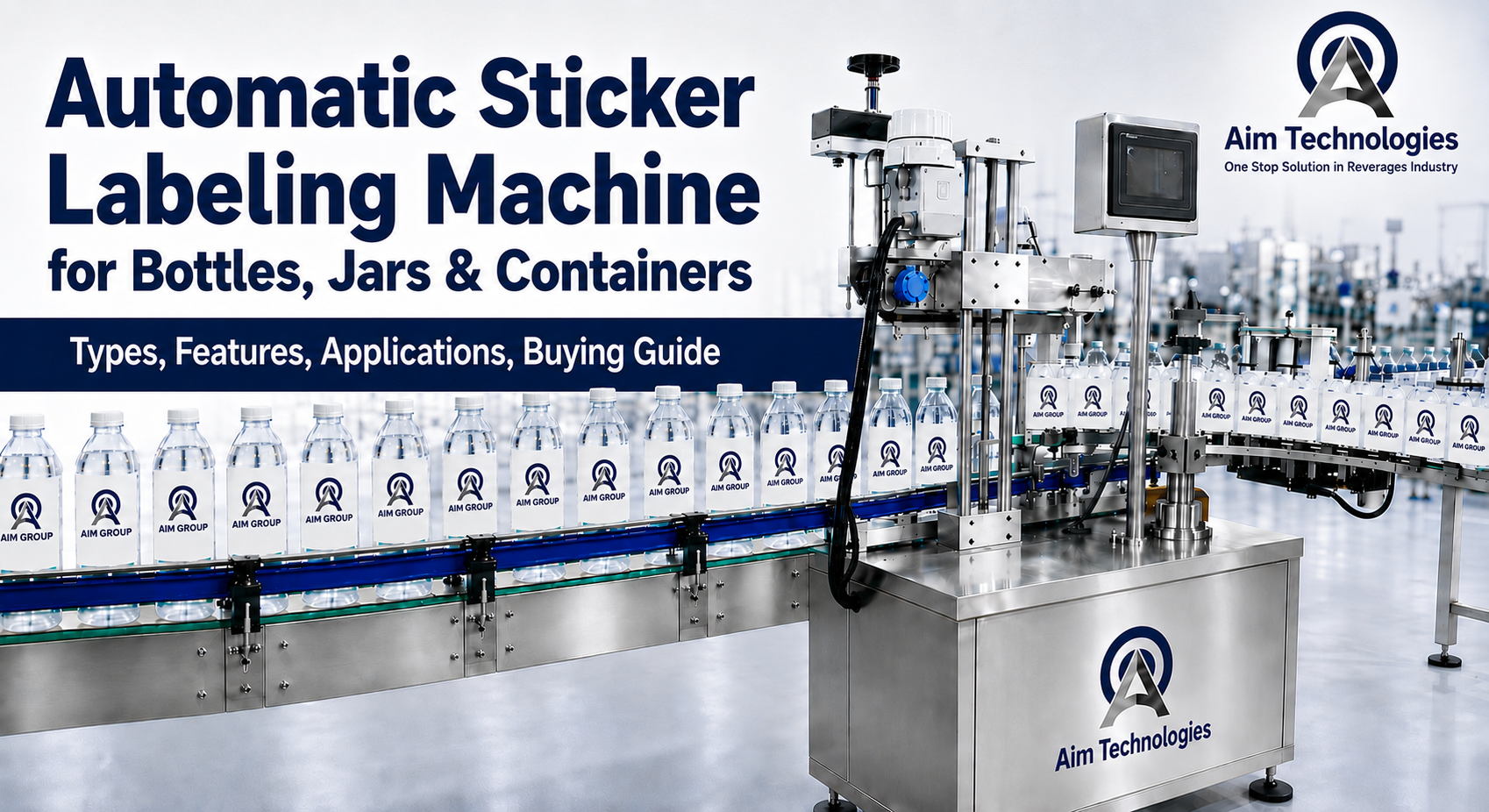
Pick up any packaged product from a shelf — a water bottle, a jam jar, a shampoo container, a pharma syrup bottle — and look at the label on it. Neat, straight, perfectly positioned. That didn't happen manually. Behind every clean label is an Automatic sticker labeling machine, quietly doing the same job thousands of times an hour without a single crooked peel.
If you're running a production line — whether it's beverages, food processing, cosmetics, or pharmaceuticals — you already know that labeling is one of those steps that looks simple but can destroy your packaging quality and throughput if done wrong. Manual labeling is slow, inconsistent, and expensive to scale. Automatic machines solve all three problems.
This guide is written for factory owners, production managers, and entrepreneurs in India who are either setting up a new line or upgrading an old one. We've drawn all the technical information directly from AIM Technologies, a leading labeling machine manufacturer and exporter based in Surat, Gujarat — with product ranges covering everything from single-side flat bottle labeling to fully customised solutions for odd-shaped containers.
By the time you finish reading, you'll know exactly which sticker labeling machine for bottles fits your production requirement, what features to look for, which industries use which types, and what questions to ask before you buy.
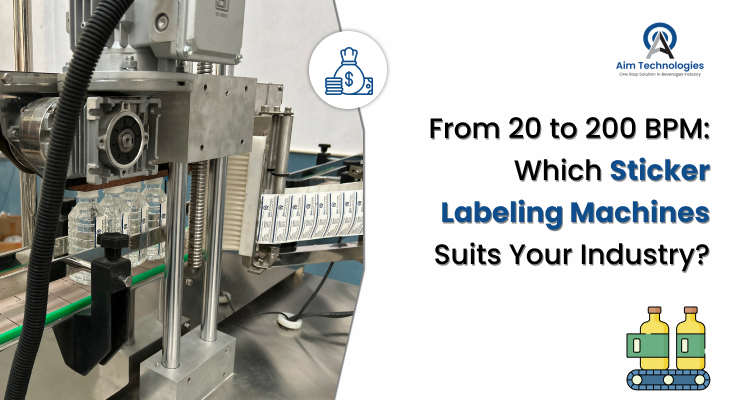
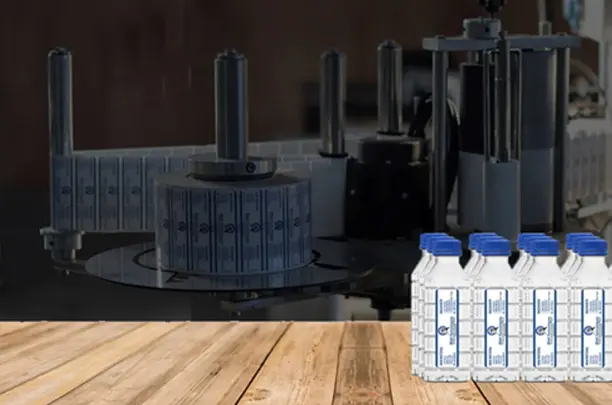
Think of it this way — every label you see on a bottle or jar had to land somewhere specific, at a certain angle, without bubbles or wrinkles. Doing that by hand for thousands of bottles a day just isn't practical. A sticker labeling machine takes that job off human hands entirely. It picks up self-adhesive labels from a roll and places them on each product passing through the conveyor — accurately, repeatedly, at speed. What looks simple from the outside actually involves a fair amount of precision engineering underneath.
The machine reads the position of each product using sensors, calculates where the label needs to go, and dispenses it with precise timing. A sensor controls the whole process — so the label doesn't land 2mm to the left, or crooked, or bubbled. It lands exactly where it should, every single time, at speeds that no manual operator could match.
Modern automatic labeling machines for bottles and containers are designed to handle a wide range of product shapes — flat bottles, round bottles, oval containers, square jars, glass vials, HDPE canisters, tin containers, and more. The machine adjusts to the conveyor speed, ensuring consistent label placement regardless of line speed.
Key Difference: A manual labeling station might get you 15–20 labels per minute per worker. A good automatic machine handles 80–120 labels per minute — and doesn't take breaks, make mistakes due to fatigue, or slow down at the end of the shift.
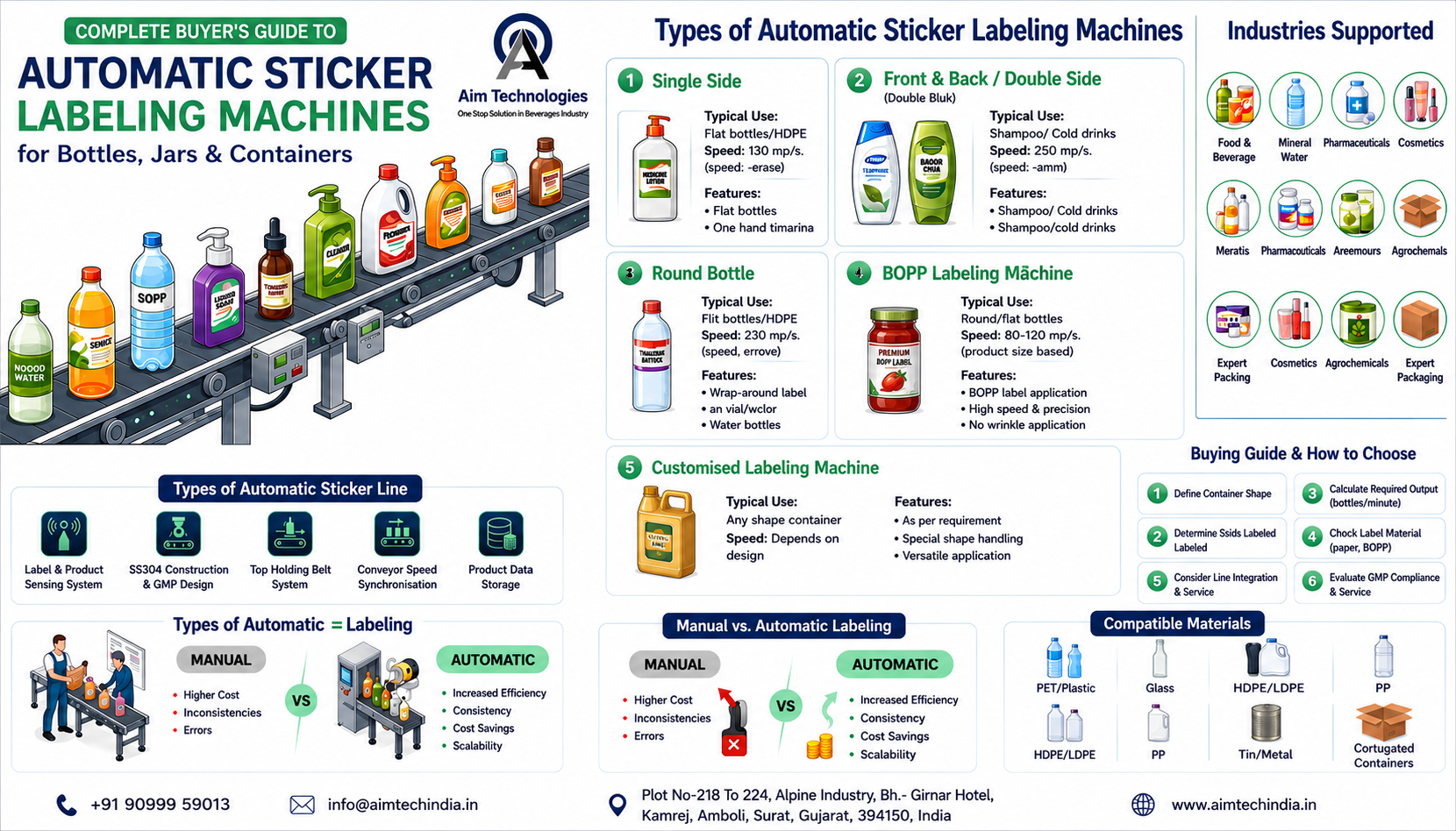
No single machine works for every product — and that's something a lot of buyers don't realise until they're already making a purchasing mistake. A round bottle needs a different setup than a flat one. A product needing labels on both sides needs a different machine than one needing a single label. Your production volume also matters — a low-capacity machine on a high-speed line will become a bottleneck fast. Below is a breakdown of what's available and what each type is actually suited for:
The single side sticker labeling machine is designed for flat bottles where you only need to apply one label on the front (or back) side. It's the most common type used in pharmaceutical, food, beverage, fertiliser, and pesticide industries.
It works well for labels that have a greater height and length — meaning large label areas on flat surfaces. The machine comes with a servo based label dispensing system and an easy sensor-based product detection setup.
Typical use: Medicine syrup bottles, oil bottles, pesticide flat containers, flat HDPE canisters.
The front and back sticker labeling machine, also called the double side labeling machine, applies labels to both sides of a container in a single pass. Model ADSL-100 from AIM Technologies, for example, can produce up to 100 labels per minute depending on the product size.
What makes this machine stand out is the automatic product alignment system that's linked to a top holding belt. This ensures the container doesn't tilt or shift while being labeled — which matters a lot when you're doing front-back simultaneously.
It handles flat, oval, square, and round containers and works with glass, plastic, PET, tin, and corrugated packaging. The PLC soft keypad lets you store separate product profiles — so switching from one SKU to another doesn't mean your operator has to reconfigure everything from scratch each time. That kind of built-in flexibility is genuinely useful when your line runs multiple pack sizes across a shift.
Key features: GMP design, SS304 construction, full security counter, accurate placement on both sides.
Typical use: Cold drink bottles, shampoo bottles, condiment jars, pharma bottles needing front label (brand) + back label (ingredients/dosage).
Round containers are trickier to label than flat ones because the surface is curved. The round bottle labeling machine is built specifically for this — it wraps the label around the circumference of the container.
AIM Technologies' round labeling machine is suitable for vials, small-size round bottles, and other circular products made of metal, glass, plastic (LDPE, HDPE, PP, PET). Larger label heights and lengths are possible for beverages, pharmaceuticals, food products, fertiliser, and pesticides.
The machine uses servo-controlled label dispensing with a label and product detection system — so even at high speeds, the wrap is tight and the label seam is consistent.
Typical use: Water bottles (round), beverage cans, pharmaceutical vials, round cosmetic jars, ketchup bottles.
BOPP — short for Biaxially Oriented Polypropylene — is a film-type label material, not paper. It's thinner, slightly glossy, and often used where brands want a clean, premium look on their packaging. You'll see it most on mineral water bottles, carbonated drinks, and premium FMCG products. In the beverage industry especially, BOPP has largely replaced paper labels because of its moisture resistance and better shelf appearance.
The BOPP labeling machine applies these film labels which sit flush against the container, giving that clean no-label look that water and drink brands aim for. Walk into any supermarket and you'll notice the best-looking water bottles almost always use BOPP — the label practically disappears into the bottle.
AIM Technologies' BOPP machines come in multiple configurations so you can match the setup to your specific bottle type. Delivery timelines are generally reliable, and the machines are built to integrate into existing packaging lines without major floor modifications.
Typical use: Mineral water bottles, carbonated drink bottles, premium FMCG products where label aesthetics matter.
Not every product fits into a standard category. If your containers are non-standard shapes — unusual dimensions, multi-faceted surfaces, or special packaging designs — a customised labeling machine is the answer.
AIM Technologies manufactures custom machines based on the specific design of your bottles and containers, including various sizes and configurations not available off the shelf. If you've got an unusual packaging requirement, this is the route to explore.
Typical use: Specialty food products, export packaging, unique cosmetic containers, industrial products with irregular shapes.
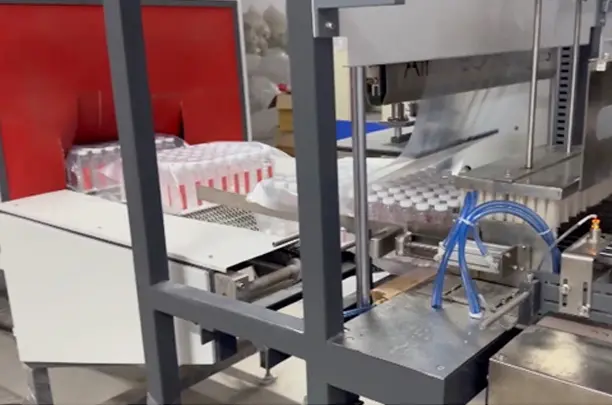
A shrink sleeve applicator is a different category from sticker labeling — instead of applying a flat adhesive label, it inserts a pre-formed plastic sleeve over the container and shrinks it tight using heat.
The AIM Technologies Shrink Sleeve Applicator performs container delivery and classification, label sleeve cutting, and accurate sleeve positioning on the bottle. It's used where full-body labeling is needed — or for tamper-evident neck sleeves.
Typical use: Juice bottles, health drinks, condiment containers, wine and spirit bottles, products needing tamper-proof sealing.
Some businesses run 4–5 different product types on the same packaging floor — different container shapes, different label sizes, different sides. Buying a separate machine for each isn't always practical. That's the problem the all-in-one labeling machine solves. It combines multiple labeling functions in one unit — so you're not running three different machines where one can handle the job. Good option if your production floor is tight on space or your product mix keeps changing.
| Machine Type | Container Shape | Sides Labeled | Ideal For | Speed |
|---|---|---|---|---|
| Single Side | Flat bottles | One side | Pharma, oil, pesticide | 40–120 per min and more |
| Front & Back (Double) | Flat/oval/square/round | Both sides | FMCG, food, beverage | 40–120 per min and more |
| Round Bottle | Round/cylindrical | Wrap-around | Water, beverage, vials | 40–120 per min and more |
| BOPP | Round/flat bottles | Single or wrap | Mineral water, premium drinks | 40–120 per min and more |
| Customised | Any shape | As required | Specialty/export packaging | Depends on design |
| Shrink Sleeve | Any shape | Full body / neck | Tamper-proof, full-wrap | 30–60 per min and more |
| All-In-One | Multi-type | Multi-function | Mixed production lines | Variable |
Before you buy, know what separates a good machine from one that'll give you headaches within a year. Here's what actually matters:
The machine should be able to detect the product position on the conveyor and time the label dispensing accordingly. Without a reliable sensing system, you get misaligned labels, especially when the line speed varies.
If you're in food, beverage, pharma, or cosmetics — GMP-compliant design and stainless steel 304 (SS304) construction aren't optional. Regulatory audits will check for this. AIM Technologies machines are built to GMP standards with SS304 frames.
This feature holds the container steady from the top while it moves on the conveyor. Without it, round or tall bottles can tilt during labeling — resulting in crooked labels. Essential for front-and-back labeling particularly.
The labeling head must capture the speed of the conveyor belt and position the label in sync. If your production line runs at variable speeds, this synchronisation is critical for consistent label placement.
Being able to save and recall settings for different products saves significant change over time. A machine with product data storage means your operator doesn't need to recalibrate from scratch every time you switch from 200ml bottles to 500ml bottles.
Almost every packaged product you can think of needs labeling. But these are the industries where labeling machines are most commonly deployed in India:
| Industry | Typical Products | Common Machine Type |
|---|---|---|
| Food & Beverage | Sauces, jams, juices, dairy, cooking oil, spices | Single Side, Front & Back, Round |
| Mineral Water / Packaged Drinks | Water bottles, carbonated drinks, energy drinks | Single Side, Front & Back, Round, BOPP, All-In-One |
| Pharmaceuticals | Syrup bottles, vials, tablets jars, drops bottles | Single Side, Round, Front & Back |
| Cosmetics & Personal Care | Shampoo, lotion, face wash, perfume, cream jars | Front & Back, Round, Custom |
| Agrochemicals | Pesticides, fertilisers, herbicides, soil conditioners | Single Side, Front & Back, Round |
| Chemicals & Industrial | Adhesives, lubricants, paints, cleaning agents | Single Side, Custom |
| Export Packaging | Multi-language labels, premium branded exports | Customised, Front & Back |
If your business falls into any of these categories, you're already dealing with labeling as a core part of your packaging line — and upgrading to an automatic machine can directly impact your productivity and output quality.
Here's a scenario that production managers deal with all the time.
You're running a Mineral Water Plant producing 28,800 bottles per 8-hour shift. With manual labeling, you need 3–4 workers stationed at the labeling point. They're tired by hour 5, labels start going crooked, rejection rates climb. You're also paying for 3–4 salaries every shift.
Now switch to an automatic bottle labeling machine. One operator monitors the line. The machine runs at 60–100 bottles per minute, doesn't fatigue, doesn't apply labels crooked, and keeps consistent placement even on Hour 8. Your cost-per-label drops significantly, rejection rates fall, and that same 28,800 bottle shift can scale to 5,000+ without adding headcount.
The payback period for a good automatic labeling machine in a mid-volume production line in India typically comes in 6–18 months depending on your current manual labour costs and production volumes.
Modern automatic labeling machines are designed to work with a very wide range of container materials:
| Material Type | Examples | Compatible Machine Types |
|---|---|---|
| PET / Plastic | Water bottles, soda bottles, oil bottles | All types |
| Glass | Pharmaceutical bottles, liquor bottles, sauce jars | Single Side, Front & Back, Round |
| HDPE / LDPE | Chemical containers, pharma jars, cleaning products | Single Side, Front & Back |
| PP (Polypropylene) | Cosmetic jars, food containers, medicine caps | Round, Front & Back |
| Tin / Metal | Lubricant cans, paint tins, aerosol cans | Single Side, Custom |
| Corrugated Containers | Shipper cartons, secondary packaging | Front & Back |
If you're labeling glass bottles — pharma or liquor industry particularly — make sure the machine you're looking at is specifically tested for glass. Glass is heavier and can behave differently on conveyors compared to PET.
This is the part where a lot of buyers go wrong — they buy the machine that looks the most impressive rather than the one that actually fits their line. Here's how to think through it:
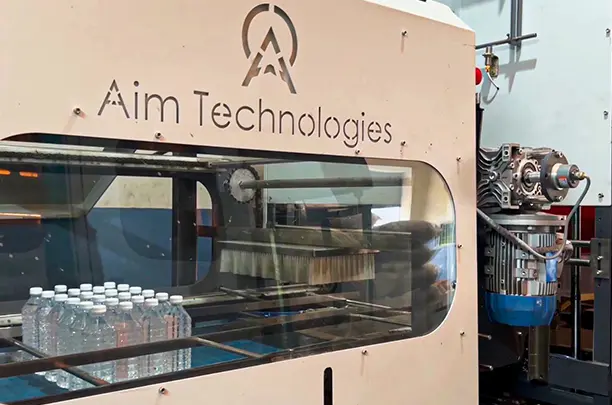
AIM Technologies is a labeling machine manufacturer and exporter based in Surat, Gujarat, India. Their product range covers Single Side, Front & Back, Round, BOPP, Customised, Shrink Sleeve, and All-In-One labeling machines — built for industries including food processing, beverages, pharmaceuticals, cosmetics, and agrochemicals.
All machines are manufactured with GMP-compliant design, SS304 stainless steel construction, and microprocessor/PLC-based control systems. AIM Technologies exports to international markets and has an established client base across India.
| Machinery Department | +91-87589 59013 / +91-99787 59013 |
| Export Department | +91 90999 59013 |
| info@aimtechindia.in / export@aimtechindia.in | |
| Address | Plot No. 218-224, Alpine Industry, Bh. Girnar Hotel, Kamrej, Amboli, Surat, Gujarat – 394150 |
| Working Hours | 9 AM – 6 PM |
| Website | www.aimtechindia.in |
These are the questions that come up again and again when factory owners and production managers are shortlisting labeling machines. Answered here directly, without the sales pitch:
A. With a sticker machine, labels come pre-coated on a roll — the adhesive is already on the label. The machine just peels and applies. With wet glue, the machine has a glue pot that coats each label separately before applying it to the container. For most factories in India today, sticker labeling is the default choice — it's easier to set up, doesn't need glue management, and changing over to a different label design takes minutes. Wet glue still gets used in large-scale beverage plants where the sheer volume makes the per-label cost calculation tip in its favour.
A. Some machines, particularly the All-In-One series and certain Front & Back machines with optional wrap-round attachments, can handle both. But generally, round labeling and flat labeling are done on different machine types. If you're labeling both container types regularly, discuss a dual-purpose or convertible configuration with the manufacturer before ordering.
A. Speed varies by machine type and container size, but most automatic machines in this category comfortably handle 60 to 120 labels per minute. The ADSL-100 front-and-back model from AIM Technologies, for instance, runs up to 100 per minute. One thing to keep in mind — if your label is physically large (long or tall), the machine needs slightly more time to dispense and place it, so effective speed comes down a bit. Always match the machine spec to your actual label dimensions, not just the bottle count.
A. Glass, PET, HDPE, LDPE, PP, tin, corrugated — most standard container materials are supported. The machines are built to handle variation in weight and surface texture across these material types. Where it gets tricky is very lightweight containers (they can slip or wobble on the conveyor) or non-standard shapes. If either applies to your product, mention it upfront when you're requesting a quote — the machine can be calibrated for it, but the manufacturer needs to know beforehand.
A. Regular sticker labels are paper-based — they work fine, but they can absorb moisture, tear, and look dull after a while on a shelf. BOPP is a film material (Biaxially Oriented Polypropylene) — it's thinner, water-resistant, and has a noticeably better finish. Hold a premium mineral water bottle next to a budget one and you'll often see the difference right away. If your product sits in a chiller, gets handled with wet hands, or needs to look premium on shelf, BOPP is worth the switch.
A. Generally yes, but "integration" isn't automatic — it needs planning. Before ordering, give the manufacturer your conveyor height, belt speed, floor space dimensions, and bottle specs. AIM Technologies works with clients to configure machines that slot into existing lines, but that only works if they have the right measurements upfront. Ordering a machine and then figuring out it doesn't match your line height is an expensive and avoidable problem.
A. If you're producing anything regulated — food, beverages, pharmaceuticals, cosmetics — GMP compliance is important for two reasons. First, regulatory inspectors will check for it. Second, GMP design (smooth surfaces, no dead corners, SS304 construction) makes the machine easier to clean and less likely to harbour contamination. AIM Technologies builds all machines to GMP standards with SS304 stainless steel.
A. Day-to-day maintenance is fairly manageable — these machines aren't high-maintenance by packaging equipment standards. The most common issue is dust settling on the label sensing eye, which throws off the label detection and causes misplacements. Cleaning that regularly prevents about 80% of labeling errors. Other routine tasks are lubricating the conveyor belt, checking the label roll tension, and occasionally recalibrating the PLC settings. Train your floor operator on these basics and most small issues get caught and fixed before they become stoppages.
A. Yes — most machines have adjustable label guides and PLC-stored product profiles, so you can run different label sizes on the same machine. Changeover time between label sizes is typically 10–20 minutes once operators are familiar with the adjustment procedure. If you have a very wide range of label dimensions (e.g., from a 30mm label to a 200mm label), confirm the machine's adjustment range with the manufacturer.
A. Pricing depends on machine type, output capacity, and how much customisation is involved. Entry-level semi-automatic machines cost less, but for a fully automatic PLC-controlled machine built for industrial production, you're typically looking at a range of Rs. 3 lakh to Rs. 10 lakh and upward depending on configuration. The best way to get an accurate number is to call AIM Technologies with your bottle type, required speed, and label details — reach them at +91-87589 59013 or info@aimtechindia.in and they'll give you a quote based on your actual requirement.
A. Yes, AIM Technologies exports. They have a separate Export Department handling international orders — you can reach them at +91 90999 59013 or export@aimtechindia.in. Machines go out to buyers across South Asia, the Middle East, Africa, and Southeast Asia. Export packing, shipping documentation, and compliance with destination country standards are managed by their team, so international buyers don't have to sort that out independently.
An automatic sticker labeling machine stops being a "nice to have" the moment your shift volume crosses a few hundred units. Beyond that point, manual labeling costs more in labour and errors than the machine would cost in EMIs. For any serious production line, it's a core piece of equipment — not an upgrade.
Getting the right one isn't complicated if you start from the basics — what shape is your container, how many sides need labels, what volume do you run per shift. Once you have that clarity, matching it to the right machine type takes ten minutes. Where people go wrong is buying on price or buying the most feature-heavy machine without checking if it actually suits their line.
AIM Technologies manufactures across the full range — single side, double side sticker labeling machine, round, BOPP, custom, and all-in-one — at direct manufacturer pricing. Tell them your container type, label spec, and required output speed, and they'll recommend what fits. No reason to guess when the manufacturer is a phone call away.
Contact us today for a free consultation and project cost estimate — call +91 90999 59013 or write to info@aimtechindia.in.

Subscribe To Our Newsletter to get the latest news, updated and amazing offers delivered directly in your inbox.
For More Details Call Us :